
AdSense Policies in Depth (1): The Complete Policy Map — What's Allowed and What Isn't, Before It Surprises You
The thing weakening AdSense accounts most is not poor content but ignorance of the rules governing it — a site owner spends a year building content, then loses the account in a week over an encouraged click or an old forgotten page. I opened this series to be your permanent guide to program policies in simple language, and this first part draws the complete map: what the policy categories are, why each exists, practical examples of violations people commit unintentionally, and how to track updates without living in constant fear. After this map, every detailed part of the series will land in its place in the full picture.
What you will do in this part:
- Understand AdSense policies' complete structure in one organized map
- Distinguish categories blocking content from those governing your behavior with visitors
- Recognize common unintentional violations sinking whole accounts
- Build a simple tracking routine for updates without permanent anxiety
Why Policies Exist: The Logic You Must Understand
AdSense is a broker between two parties: an advertiser paying money for real attention, and a publisher displaying ads for a share of that money — and policies are the contract protecting both from fraud. The advertiser wants the ad shown to an interested human, not a robot generating clicks; the honest publisher wants no cheaters ahead of them raising prices and staining the network's reputation. Every policy clause translates this logic into a practical rule, and whoever understands the logic deduces new judgments alone without waiting for explanations.
So read policies not as a memorized list of prohibitions but as a frame protecting your livelihood: the site violating them loses not only its ads but the advertisers' trust in the whole network, which is why Google handles violations with severity reaching full account suspension in serious cases without repetition. A suspended account is very hard to recover — prevention is hundreds of times cheaper than cure, and that is the only reason reading this series is an investment, not a pastime.
Category One: Content Policies — What Gets Published
The first and largest category governs content itself, with two doors: fully prohibited content unsuitable for the network at all, and restricted content displayable under conditions. Prohibited includes content copied from other sites without permission, misleading information and false claims, violent graphic material, content targeting self-harm or child endangerment, and sales of certain drugs and weapons. Restricted includes sensitive content like breaking news, disasters, health, and money — acceptable with quality, accuracy, and proper disclosure.
Small sites suffer here more than large ones because the violation's share of total content is larger: one violating page of ten is a tenth of the site, while on a large site it is a quarantineable exception. The practical rule: review your full archive once when opening your account, remove or fix any prohibited page, add proper disclosures to restricted content, then make the prohibited list a measure for every new article before publishing. I covered how reviewers check this point before approval in the approval checklist — the same check continues after approval.
Category Two: Original Content — The Heart of All Policies
Google pays advertisers for attention gathered by valuable content, and therefore requires the content shown beside ads to be original and valuable. Original does not mean a new topic — it means personal processing through your experience, language, and audience context; and valuable means the reader genuinely benefits. Content copied from other sites, or mechanically rephrased by tools without real addition, or aggregated from sources without processing — all are cases the system treats as low-value content, restricting or blocking ads on them.
This category is the widest applied and the most sinking for new sites, because its boundary is unclear to the untrained: two articles on the same topic, one original and one a copy, the difference lying in processing, not the title. This series dedicates a full part to dissecting originality with practical standards you can check before publishing, and another to internal and external duplication — do not rely on your feeling alone but on a clear checklist. And for anyone preparing a site for approval now, this category is the core of what the reviewer examines, as I explained in the content plan article.
Category Three: Click and Ad Behavior — What You Do
A full category governs your relationship with ads after they appear, and its most dangerous clause is encouraging clicks: you may not ask anyone to click your ad directly or suggestively, may not place text, image, or arrow directing eyes to the ad, and may not click ads on your own site for any reason. Clicks generated this way are called invalid clicks — the fastest road to suspension.
We dedicated a full part to them in this series because they are the most common downfall of Arabic sites especially, with circulating "share the link and support with a click" advice — together with invalid traffic arriving from artificial sources as detailed in the invalid traffic article.
This category also includes placement rules: no ad disguised as content where a visitor taps it by mistake, no ads on pages without real content like thank-you and notification and 404 pages, and no ads near interactive buttons where clicks get misread. All these rules ultimately protect your own interest — the mistaken click creates no earnings but creates advertiser complaints and low quality scores dropping all your ad prices.
Category Four: Data Privacy and Compliance
Google's ads rely partly on cookies and browser signals, and this data has global laws requiring disclosure and consent — so AdSense policies require your site to own a clear privacy policy explaining cookie use, and to comply with privacy laws of your visitors' regions, especially the EU and UK with their consent requirements. This is not a rare legal detail but an actual checked condition, and an honestly written privacy page suffices in the vast majority of cases when it truly explains what happens.
This series dedicates a full part to data privacy and another to affiliate disclosure, because disclosure is not only moral honesty but a policy obligation when mentioning products or services for compensation. The unifying rule of this category: whoever collects visitor data or shows targeted ads must tell the truth and give a clear choice — a principle governing your whole site from the first page to the last footer.
Category Five: Technical Ad Implementation
The last category governs how the code itself is implemented: modifying ad code or manipulating its display or hiding parts of it is prohibited, as are ads in pop-ups or behind navigation buttons, and ads displayed with content loaded from unauthorized sources. It includes partner rules too: do not use unapproved intermediaries managing ads on your account, and do not share your account with a party whose practices you cannot vouch for — you are responsible for what happens on your account even if someone else did it.
The common technical mistake beginners fall into unintentionally: copying ad code from another site to test, or placing an ad unit inside an element hiding part of it on small screens, or using automation plugins altering ad behavior. All fall under implementation with real risk — the solution is simple: implement ads with official code as-is, in policy-allowed positions, and never test anything on a live account.
| Category | What it governs | Most common mistake |
|---|---|---|
| Content | What may be published and restricted | An old prohibited page the owner forgot |
| Originality | Content's origin and value | Mechanical rephrasing without real addition |
| Click behavior | Your relation to ad display and clicks | Text encouraging visitors to "support by clicking" |
| Privacy | Data and disclosure | No privacy policy explicitly mentioning cookies |
| Implementation | Code and technical placement | Modifying code or ads on empty pages |
Unintentional Violations: The Most Dangerous Because They Are Silent
Deliberate violators are few — unintentional violations are the real account-sweepers, because they never enter your awareness so you never guard them: an article written years ago in a style once acceptable but changed by policies, or a download page holding another network's ad links, or old text thanking readers for clicking support before you knew it was an explicit violation. These errors carry no bad intention, but automated reviews collide with them, record them, and they accumulate until a wave of action surprises an owner who thought themselves entirely innocent.
The defense line against this violation type is periodic review, not momentary enthusiasm: review your archive quarterly against current policies, not publish-day standards; search your site for words like "click" and "support" near any ads mention; and examine old download and embed pages. One hour every three months protects you from a surprise shattering a year of work — the best time-return ratio in managing an entire site.
The Difference Between Page Restriction and Account Suspension
Not every violation means losing everything — the system escalates by severity and repetition: the least serious is restricting ads on the violating page or section only, the rest of the site working — an early signal granting a fix chance. Then account-wide effects through declining ad bids as quality numbers worsen; and the most severe, full account suspension — a decision very hard to reverse, leaving a permanent mark on your file. Understanding this gradation changes your behavior entirely: a small warning is not a worthless notice but the last mercy door before the closed one.
Log every notice the system sends however small, and document your response: what you fixed and when — this record matters in any later review, separating a publisher ignoring warnings from one managing responsibly. The general rule summarizing it all: act as if every violation, however small, reached a desk deciding your account's fate — because often that is literally what happens; the difference between levels is practice, not luck.
Violation Notices: How They Arrive and What They Mean
The system informs you through account email and the dashboard, and official messages come in two types: a warning notice naming the violated category, usually with the page or pages involved; and an action notice indicating restriction or suspension. Every official message references the violated policy clause — that reference is your search thread. Read the message not with feelings of injustice but with an investigator's feelings: what clause? Where did the violation occur? How exactly do I fix it?
After fixing, use the review or appeal path mentioned in the message if available, and write your request short and objective: what you fixed with dates, not your feelings about the decision. Whoever sends an emotional paragraph about years of effort gains nothing; whoever sends a documented fix list examined clause by clause wins in many cases the difference between restoring the account and losing it.
Your Old Archive: A Danger Zone Hiding in Quiet
The most dangerous pages on your site are not those written last week but those written years ago then forgotten — policies move while content stays, and an article acceptable in its wording, sources, or style three years ago may sit today on a red line you never drew. Added to that, old archives accumulate download pages, embeds, and referral links no longer valid — all potential check points crawlers collide with during their normal rounds.
Put a full archive review against current policies in your yearly schedule, starting with the most visited pages since they face the most checking, armed with the five categories of this map. The double payoff justifies the effort: a site compliant with current policies, and an updated archive regaining its search strength — the policy review here is itself a hidden SEO improvement opportunity only consistent blogs seize.
Your Audience's Role in Your Compliance File
Your site does not live alone: visitors write comments and share your links in contexts you do not control, and these activities build part of your file before the policies. Open comments without monitoring are a back door to violations you never know of — a visitor may drop a link to a violating site or prohibited text in a reply, and the system does not distinguish what you wrote from what got published on your page. Set your comments policy with manual review or automatic filtering, remove anything touching prohibited content immediately: this is part of site management, no place for personal laxity or neglect.
As for visitors sharing your links, the philosophy is double-edged: traffic from natural sharing is fine, but if you explicitly encourage your audience to click for support, or through groups exchanging clicks, you plant invalid traffic on your own land with your own hands — account suspension there is a matter of time, not chance. Build your audience on the value they read, not on the illusion of clicking kindness: the audience that reads stays and grows, pushing your article's value forward; the audience that clicks disappears the moment the account suspends, never returning after.
Tracking Updates Without Anxiety
AdSense policies update from time to time, and permanent anxiety over every update is worse than underestimating them — the answer is a middle routine: review the official policies page monthly; follow AdSense's official blog or media account where major changes are announced; and at any major update read the change against your site's measure: does it touch what I publish? My positions? If no, nothing changes in your work; if yes, read the detail in this series first, then apply.
Also do not read people's explanations of updates before reading the official text itself — explanations accumulate interpretations and fear, while the official text is usually clearer than its portrayals. This part of our series is exactly the bridge between official language and yours: we translate every category into practical examples and real cases, so an update you read means something concrete to you, not a legal sentence passing by.
How to Use This Series Practically
Read this map part, then read the detailed parts by your priorities: a new account starts with the original content part then click behavior; if you doubt old practices, start reviewing the prohibited list; if building a site for new approval, start with data privacy and disclosure. Every part closes with a practical checklist applying to your site immediately — do not read the series casually; each part will save you at least one error that would have cost you a lot.
Then install the application tool: one page in your notes titled "my site's compliance log" recording each review's date, findings, and fixes. This log becomes over time your proof of honorable practice before yourself, and if your account ever faces a manual review, you hold a log proving serious management. Policies are not the publisher's enemy — they are the game's rules from which whoever understands them earns stable income for years, and whoever ignores them loses everything in a week.
Questions From First-Time Policy Readers
Are policies the same for everyone regardless of site size?
Policies are one for all publishers with no size exceptions, but violation impact magnifies on small sites as its content share grows. Real variance appears in restricted content: a specialized medical site needs higher disclosure and accuracy than a general recipes site. Read policies fully regardless of size, then measure details against your specific niche — that is the map's correct use.
Am I responsible for my visitors' comments?
Yes — content displayed on your site is your responsibility including visitor comments, and policies require monitoring user-generated content against the prohibited list. Enable manual review before publishing comments or monitor daily with filtering tools, block links and images in comments if you cannot monitor them, and remove any violating comment on sight. Unmonitored open comments are a back door to violations you never know of.
Can I show another network's ads beside AdSense?
Yes within clear organizational limits — the problem is not multiple networks but visual similarity deceiving visitors into mistaking ads for site content, and ad density outweighing content. Keep ads visually separated, keep density reasonable, and review the other network's policies too since some prohibit co-existence. Best at the start: one network you fully manage, expanding after proving you handle the first with excellence.
What happens if I violate unintentionally?
Impact varies by violation type: some draw a warning or restriction on one page, serious ones suspend the account first time. If a warning arrives, handle it immediately: read the cause, fix the violation, and request re-review if the path exists — quick honest response protects your account. Do not argue the system without evidence: a warning is not an opinion question but a pointer to a specific error needing fixing, not debating.
Part One Summary
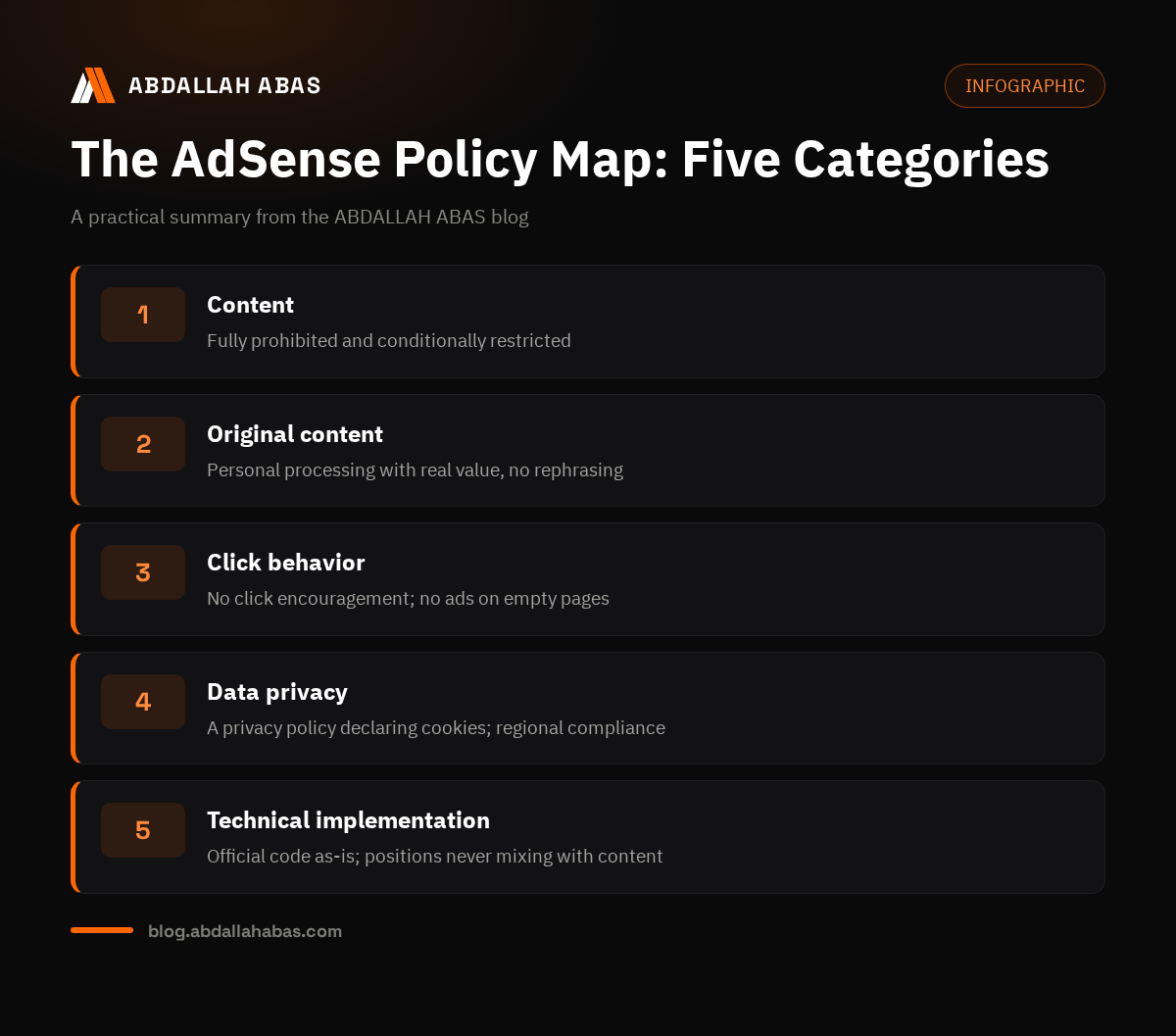
The AdSense policies map divides into five categories: content and what it allows, originality as the equation's heart, click behavior and your relation to the ad, data privacy and disclosure, and technical implementation of the code. Whoever memorizes these five reads any new policy clause knowing instantly where it sits and why it exists; whoever understands their logic — protecting advertiser and publisher from fraud — deduces judgments alone. This part is the series' gate; coming parts give each category practical explanation and checklists. Follow them by your site's priorities, and start today reviewing your archive against this map's list before the system starts reviewing you.
Comments