
Invalid Traffic in AdSense: How It Reaches Your Account and How to Protect It in Time
Among the most alarming messages a hardworking site owner can receive is the invalid traffic warning — it frightens more than it explains, and in forums it turns into horror stories convincing some that the account is over before it began. The truth lies between fear and recklessness.
Some of these cases end some cases end with a simple warning and monitoring, others develop into full suspension, and the difference between the two is not luck but your understanding of what is happening and your fast, correct action. In this article I unpack what invalid traffic actually is, how it meets your account although you violated nothing, the early signals in your reports, and the steps of protection and response — from experience managing accounts and fixing sites that went through it.
What you will actually do after reading this article:
- Understand what the system classifies as invalid traffic or clicks, precisely
- Recognize the real danger sources arriving unintentionally
- Read your early signals in reports before they become warnings
- Execute a practical protection plan on your site today
Invalid Traffic: A Practical Definition, Not a Legal One
Invalid traffic is any visit or ad interaction not representing an interested human honestly reading your site — the system has patterns distinguishing this with precision beyond what most publishers imagine. The category includes: repeated clicks from the same person in short windows, visits from automation tools and bots, clicks from people who know you responding to a support call rather than genuine ad interest, traffic bursts pumped artificially to inflate your numbers, and even malicious visits from a competitor deciding to flood your account with furious clicks to frame you as the clicker.
Note that last point — it is both the most frightening and the truest: a competitor can buy you a wave of artificial clicks, and the system, discovering the pattern, sees your account benefiting from invalid interaction whether you caused it or not. Here understanding matters: the system does not punish intent but pattern, and your mission is proving your site's natural pattern is different — a defense prepared before the crisis, not after it.
Danger Sources That Arrive Without Your Intent
The first and most common source in Arabic content: mutual-support groups where members click each other's ads — even if you joined for other reasons, all its clicks are invalid by pattern, and it is the fastest known road to suspending a new account — one of the click-behavior dangers mapped in the AdSense policies article. The second source: random sharing campaigns — posting your article link in large untargeted groups with an implicit participation call brings frenzied fast-bouncing visits unlike your real audience, which the system reads as an anomalous wave worth examining.
The third source: paid campaigns on your links from cheap platforms selling cheap traffic — however tempting the offer, cheaply paid visitors hold no genuine interest in your content, and their behavior pattern — fast entry, faster exit, random clicks — matches artificial movement patterns. The fourth: external embeds — another site displaying your pages inside frames or an aggregator tool, sending visits from an environment you do not control carrying abnormal behavior. Avoid all these sources entirely: none offers real gain comparable to its risk.
Early Signals in Your Reports: Detecting Before the Warning
The system does not jump from full silence to a sudden warning — it leaves traces in your reports you can read early: an unexplained click surge with flat or oddly rising CTR, a visit explosion from a country or source not matching your audience, or sudden earnings decline despite stable visits as the system starts excluding suspicious clicks' revenue before any warning — the same weekly reading habit I explained in the Search Console guide. Open your reports weekly comparing traffic sources, clicks, and earnings together — the anomaly you see today is what the system saw days ago.
Give special attention to the clicks-versus-social-shares relationship: one post spreading in a large group can bring a wave of clicks from people supporting you without ad interest — a classic pattern warned against. Never prevent sharing — your audience is free — but never call for it in a "help me by clicking" spirit, and if a large sharing wave happens, watch your reports closely in following days, keeping report screenshots before and after the wave: that documentation helps if you ever need to explain the incident.
What to Do the Moment an Invalid Traffic Warning Arrives
First step before anything: no emotional outreach and no random hasty action — open the message and read its stated time window precisely, defining the days the system detected the pattern. Review exactly that window: what did you publish? Where did you share links? Did you add any new tool or embed? Launch any campaign? This time-based review reveals the wave's source clearly in the vast majority of cases — write what you find in a dated, screenshot-backed report.
Second: fix the wave's source immediately even if unintentional — exit any mutual-support group however enthusiastically you joined, stop any cheap-traffic campaign, remove any suspicious embed, and add to your site policy an explicit line asking visitors not to click in support. Then write the warning's reply if a response path exists: short and objective, stating what you found, fixed, and will prevent — in facts language, not emotional apologies. This wording differentiates decisions in reconsiderations.
Third: define your site defensively — a working contact page documenting your responsiveness, your real identity visible on site: a known-identity publisher responding with organized speed is stronger in any review. And do not rebuild your site's structure in reaction to the warning — that increases suspicion rather than reducing it; the required fix is surgical, aimed at the problem's source, not blind reconstruction.
| Signal | Meaning | Your correct response |
|---|---|---|
| Clicks rise, earnings flat | System excluding suspicious clicks | Watch the source, search for a sharing wave |
| Visits from strange country/source | Artificial movement or deliberate flooding | Check embeds and campaigns, stop them |
| Official warning message | System confirmed a pattern | Time review, fix source, documented reply |
| General bid decline | Site quality score dropped | Review visitor experience and ad positions |
Preventive Protection: Five Habits That Save Your Account
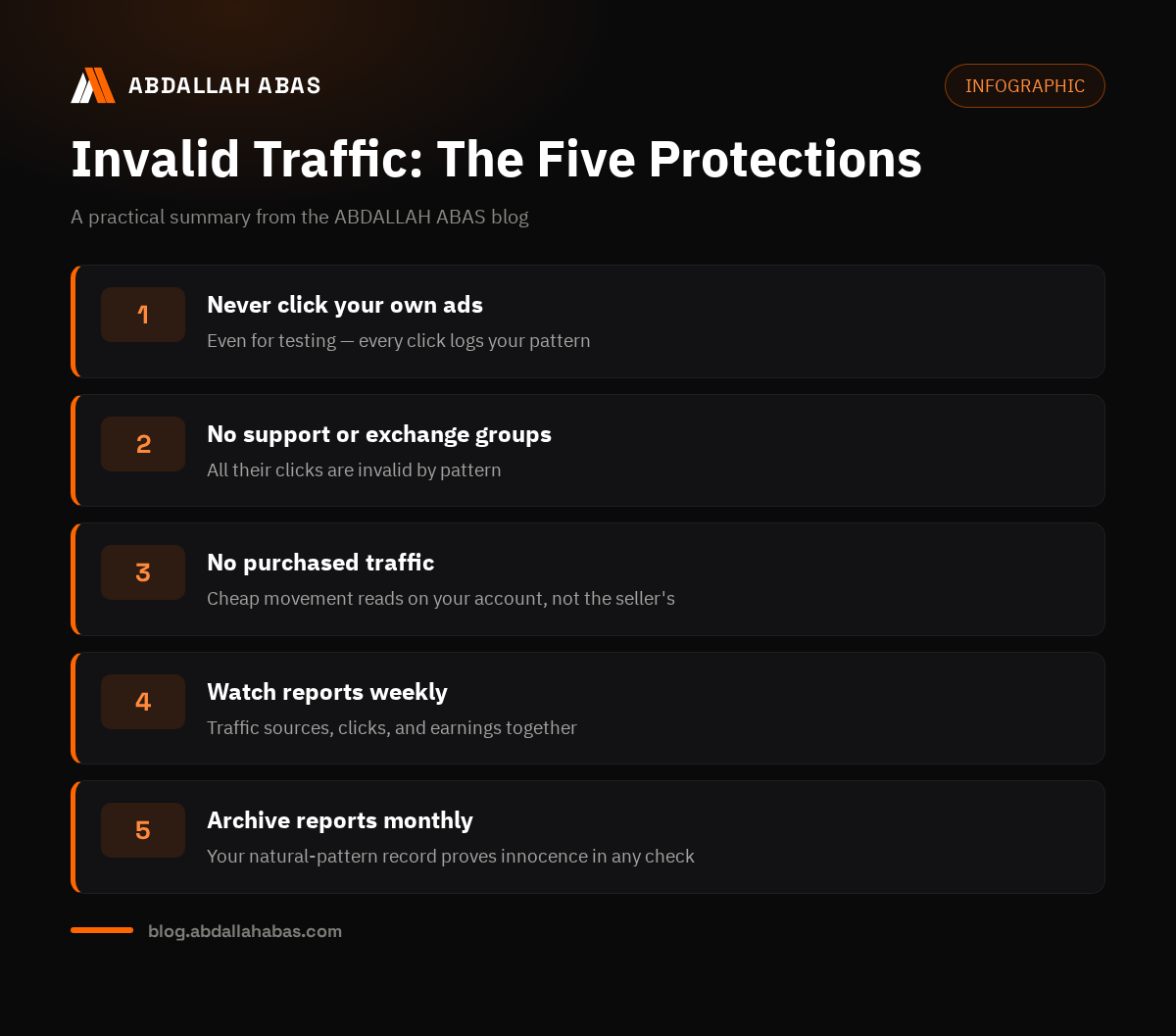
The first habit, simplest and strongest: never click ads on your own site for any reason, even "for testing" — every click of yours is logged with your address and timestamp, and small accumulations form a pattern. Second: never share your links in any support or traffic-exchange group whatever its name — these groups all end in the same record. Third: never buy visits, clicks, or social signals from any provider — by their nature all are invalid movement read on your account, not the seller's.
Fourth: monitor your embeds and outbound links periodically, checking whether your site appears inside other sites' frames dragging contextless traffic — you can block frame display of your site with a simple header setting. Fifth: keep a monthly report archive with screenshots showing traffic sources and clicks — this archive is the record of your natural life proving any anomalous wave is not your pattern, the strongest defense file if you ever need to explain an incident. These five habits cost under an hour monthly and protect an asset worth a year of work.
Ad Placement and Confusion: When a Click Loses Context
Not all invalid clicks come from visitors — some are born from the page design itself when ads sit in positions inviting wrong clicks: an ad unit too close to a navigation button or download link, an ad disguised as a site button, or an ad appearing suddenly covering a relied-upon button the visitor mistakenly taps. All these cases the system reads as clicks not expressing genuine interest, and their repetition forms a pattern calling for review — even with good intentions and unintentional technical slips.
Review your ad positions through a hasty visitor's eyes: can they distinguish ad from site elements at one glance? Are there gaps between buttons, menus, and ads protecting the accidental tap? Test pages on a small phone screen where spaces tighten and errors grow likelier, and fix every position mixing the ad's borders with content's borders. Clean positions protect you from a hidden signal and serve visitors simultaneously — among the cheapest site fixes with the highest return on account safety.
Common Stories Worth Learning Before Living Them
A recurring pattern I always see: an eager new site publishes its article in a large family group titled "support me by clicking the ads," receives an enthusiastic wave of clicks from relatives and friends, days later a formal warning arrives, and after weeks full suspension if repeated. Every link of this story was preventable with one unwritten sentence — and the saddest part is that the owner's site was genuinely good: the loss here is not punishment for bad content but for bad surrounding behavior.
Another, more malicious pattern: a stable site running for years wakes to a strange click wave from an unknown country, discovering a competitor or personal enemy bought it a "click attack" to trip the system. Whoever lives this with a clean report archive proving their natural pattern usually exits with a clarifying warning; whoever holds no record faces a hard equation proving innocence. This is the practical difference between managing an account professionally and believing report-reading is a luxury for professionals only.
Monthly Checks That Lock Danger Outside Your Account
Build a half-hour monthly check routine covering four fixed axes: review the traffic-sources report comparing to last month, hunting any new incomprehensible source; check the referring sites list in your analytics to see who brings your visits; review clicks versus earnings hunting unexplained gaps; then check your most-visited pages' embeds and whether your site appears inside foreign frames. These four checks need no deep technical expertise, only a consistency habit — turning danger discovery from a painful surprise into an early note handled calmly.
Add a simple technical defense line: some free protective scripts detect abnormal click patterns on your site and block suspicious traffic addresses before reaching ads — they do not eliminate the danger entirely but reduce its size and give you an extra log to show when needed. Do not over-install tools — excess slows your site: one good tool with your manual routine suffices a mid-size site; protection is a system of behavior and monitoring, not a pile of tools collected and forgotten.
Protection and Growth: Not Conflicting Interests
Some imagine protection limits growth — the truth is the exact opposite: everything protecting your account from invalid movement is the same thing raising your ad quality and prices. The advertiser finding a genuinely interested audience pays more for exposure on your site, and the system raises your bids as your quality numbers improve. Protection is not an earnings brake but their stable condition: earnings built on suspicious clicks are either excluded or end with the whole account, while earnings built on a clean audience remain, grow, and attract better offers.
Look at it from the advertiser's own interest — the actual financier of this whole system: they pay hoping a visitor becomes a customer, so every interestless click is their loss, and every site protecting its audience quality is their favorite partner. This simple thinking filters all your decisions: does this action bring me a visitor who understands and cares about my content? If yes, you are building earnings; if no, you are inflating empty numbers paying their price later. This one criterion replaces hundreds of conflicting tips circulating in this topic, always returning you to the base: the visitor's real value is the origin of everything.
The content plan serving this value — from choosing topics that attract genuine searchers to protecting traffic quality at every promotion decision — is detailed in the approval checklist, and it remains the strongest protection layer any account can hold. Keep it beside your reports, and every anomaly you meet will have a context to compare against.
Questions People Ask About Invalid Traffic
Can my account be suspended for visitors clicking without intention?
Individual accidental clicks are a natural part of any large site, and the system handles them statistically, excluding their revenue — the problem is not one click but a repeated pattern supported by directed behaviors. What endangers you is encouraging clicks, sharing links in a support spirit, or appearing in exchange groups; the accidental visitor clicking wrongly is statistical noise, not a penalty record. Make your criterion: does this behavior come from genuine content interest or a wish to support me? The first is legitimate income; the second is silent danger.
Can I know who clicks my ads specifically?
No — click details like clicker identity and addresses are data the system never shows publishers for strict privacy reasons; your reports show aggregated patterns: CTR, sources, countries, devices. That suffices for spotting anomalies and deciding, and does not suffice for chasing individuals — so invest your monitoring energy in reading patterns, not tracking persons, which is neither available nor useful anyway.
Should I report a click attack I suspect from a competitor?
If a clear anomalous wave arrives without a warning, the correct step is documenting it with report screenshots and checking its sources, stopping whatever causes you can. If a formal warning arrives, use its attached response path with your documentation attached. No proactive reporting mechanism exists for attacks not yet detected, but a ready archive and documented response are your full weapons when asked — do not wait for crisis to build your archive; an archive gathered on crisis day loses all evidentiary value.
Do my relatives' test clicks harm?
Yes — every click from someone who knows you counts within the "acquaintance clicks" pattern the system knows well, among the clearest invalid patterns. If you want a relative to see your site, let them read its content and never touch its ads — tell your household explicitly; a two-minute conversation protects your account from the clearest danger source. Real performance testing runs on anonymous visitors' data, never on acquaintances' clicks.
Conclusion: The Account Is an Asset Deserving a Protection System
Invalid traffic is not a horror tale but a supervision system with clear features — whoever understands its patterns — starting from the map in the AdSense policies article — protects themselves with simple habits: no click encouragement, no exchange groups, no purchased traffic, weekly report monitoring, and a documented archive proving your natural pattern month after month. Whoever receives a warning works methodically: time review, source fix, documented reply — no emotion, no recklessness. Your AdSense account is a long-term asset deserving an organized protection system growing with it, and if you want someone building this whole system with you from protection to measurement, that is part of my AdSense preparation service.
Comments