
Earning Sources (1): The Full Map of Blog Income — Where the Money Actually Comes From
The earning sources series opens with the question most starters get wrong: where does blog money actually come from? The common answer "from ads" is true and incomplete at once — ads are one source from a whole family, each source with its logic, conditions, and fitting stage. Whoever understands the full map builds a mix fitting their site and audience; whoever knows one source assumes all income is banners, then despairs when numbers slow. In this part we draw the full map honestly: what each source is, when it fits you, and what nobody should promise.
What you will do in this part:
- Recognize the four income families from blogs and each one's logic
- Match each source honestly with your site's stage and audience size
- Understand why no single mix suits everyone
- Avoid diversification mistakes harming the site instead of enriching it
Family One: Ads — Selling Attention Honestly
Ads come first to mind and are the simplest to operate: ads display on your pages and you take a share of impression and click value — the most famous network being AdSense, whose full road we covered in the Road to AdSense series. This source's strength: no selling, no service — just display. Its weakness: low per-visit value — thousands of visits make modest numbers except in niches where advertisers bid high, like finance and tech.
Ads fit a site with a wide search audience and content page views, and struggle on a small site with a thin audience however good — its equation is simply volume. They come after approval with rules you keep: positions never crowding content, reserved dimensions never shaking the page, and zero click encouragement as detailed in the invalid traffic article. Whoever starts with ads starts with the most honest easy source — but should never stop there, for its ceiling is the network's design, not your effort.
Family Two: Affiliate Marketing — The Studied Recommendation
You recommend a product or service you trust through your affiliate link and take a commission on each subscription or purchase through it. Its strength: each conversion's value far exceeds a click's value. Its weakness: it needs a trusted audience and honest evaluative content, and your credibility is its real capital — one inflated recommendation burns trust built over months. Whoever writes reviews commits to explicit disclosure of their affiliate relationship — an ethical and policy condition together.
Affiliate fits purchase-decision niches: tools, hosting, courses, equipment — where the reader genuinely seeks a recommendation before deciding. It fits comparison content: "best," "alternative," "vs" articles answering a real decision question. Pure educational blogs with a learning, non-buying audience run it weakly — and that is fine, for not every blog is a hidden store. The series dedicates a full part to this family with company-selection criteria and honest review methodology in coming parts.
Family Three: Services — Selling Your Time and Expertise Directly
The oldest income source and the fastest to realize: you offer visitors a service you execute — web development, AdSense preparation, consulting, content writing. Its strength: it works from the first interested visitor with no volume waiting. Its weakness: it ties income to your time, its ceiling being what your hands can execute. This is the family this very blog relies on beside its future ads — the "request a service" buttons you see on every article are its gates, and the service request page gathers what I offer completely.
Services fit every site however small, and are the best starting source before anything else — they turn the first ten engaged visitors into potential clients without volume. Their success needs three things: a clear services page describing what you offer, for whom, at what scope; working contact channels; and seriousness proofs reassuring the visitor — past work, testimonials, or a CV showing expertise. Whoever believes services need a big site should read the opposite: they are the only source not waiting for an audience, which is why I advise them to every beginner.
Family Four: Your Digital Products — Create Once, Earn Repeatedly
You produce something once — an ebook, a template, a course, a tool — and sell it endlessly afterward. The highest-ceiling family and the slowest to mature: it needs a confident audience, a painful problem worth paying to solve, and serious production from you, not a rushed file. It fits whoever owns content proving repeated demand on one topic — the successful product is usually a deepening of what your audience repeatedly asked you for free.
This family comes at the end of the timeline, not the start: whoever launches a product before an audience builds a store with no visitors, while whoever builds content then listens to their audience's questions finds the product designing itself from inbox questions. This is the whole series' journey: starting from what works today, arriving gradually at what builds recurring income, with no jumps demolishing what came before.
| Family | Works best when | Struggles when | Operating effort |
|---|---|---|---|
| Ads | Wide search audience | Small site, few visits | Low after setup |
| Affiliate | Purchase-decision niches | Educational non-buying audience | Medium: evaluative content |
| Services | Any stage, any size | One unable to commit to execution | High: your own time |
| Your products | Confident audience, painful problem | Start with no audience | High production, recurring return |
The Mix Rule: Two Working Beat Four Sleeping
The most common diversification mistake: opening many families at once — your effort scatters and all sit half-ready. The practical rule: two active sources beat four semi-dormant, because every source needs maintenance, measurement, and improvement, and attention divided across four melts. The starting mix I recommend: your services first — they wait for no volume; then ads after approval — they ask nothing of you afterward; then affiliate when evaluative content answering real purchase decisions appears; and postpone your product until your audience actually asks for something.
Each source has its judging metrics: ads measure RPM and traffic sources; affiliate measures conversion rate and review honesty; services measure monthly requests, response speed, and completion rate; products measure sales, refund rate, and buyer satisfaction. Review your mix's metrics monthly and decide: who grows and who retires — diversification is not permanent collection but portfolio management changing with your stage.
The Content-Quality Relation: Ground Before Planting
All four families plant on one ground: your content's quality — whoever ruins the ground plants nothing: ads earn on pages whose readers deserve to stay; affiliate converts on recommendations from a writer who tried; services require a visitor who read you and trusted your expertise; products sell to those who read you and believed your understanding deeper than others'. So every income decision starts with the content question: do my pages deserve to be built upon?
This logic flips many questions: instead of asking how to increase earnings from a mediocre site, ask how to raise the value of every existing visit through deeper content, clearer intent, and a cleaner experience — the first treats symptoms, the second fertilizes ground. The big-earning sites you envy are not magic markets but strong archives planted before harvest, and you are now in planting season, not harvest — which does not shrink your goal but orders its agenda.
Reading Each Source's Viability Through Its Numbers
Each family has two numbers sufficient for a primary judgment: ads read RPM — earnings per thousand impressions — and traffic sources: rising RPM with stable visits signals health; rising visits with flat RPM signals expansion room. Affiliate reads conversion rate — the share of sent visitors who buy — and commission per subscription: sending a hundred visitors with three purchases is a living source however small the traffic.
Services read monthly request count, response speed, and completion rate — three monthly requests with good delivery outweigh thousands of ad impressions on a small site. Products read first sales, refund rate, and buyer satisfaction — hundreds of sales without complaints signal maturity justifying expansion. Learn reading two numbers per source before adding the next — that is the difference between managing a portfolio and chasing numbers.
Audience-Readiness Lesson: Do Not Sell Before They Ask
The most common failure in families two and four: selling before any demand appears — a writer spreading affiliate links across their first articles with no accumulated trust, or launching a product nobody asked about, then concluding the source failed when the truth is the timing preceded its time. The readiness signal is simple: when your audience starts asking you for recommendations or paid solutions in their messages, that is the next family's bell.
So make a monthly habit of reading your messages and comment questions with an opportunity eye: a repeated question about a specific tool is a comparison-article opportunity earning affiliate later; a repeated request for help applying what you explained is a service-page opportunity; three questions about details of what you cover are an ebook answering them once. Your audience writes you the map of your coming sources — whoever reads their messages reads their future.
Real Site Examples: Who Earns From What and Why
Look at four real recurring patterns in the Arabic web. A tech educational blog with a read-and-leave audience: ads work on search volume; its affiliate is weak because the audience buys no tools; but training or setup services succeed, turning interest into application. A comparisons blog for tools and hosting: affiliate is the heart of its income because every article answers a purchase decision, with ads as a secondary completing layer.
A recipes or travel blog with beautiful images and huge traffic: ads earn well by volume; affiliate works in supporting gear — kitchen, luggage; and printed products like recipe books work nicely. A personal consulting blog with demanded expertise: services are the core income from month one, with ads adding a later secondary layer. Note all four are correct — the difference is the audience-intent composition, which is exactly why no single recipe suits everyone.
Your Site's Stages and Their Fitting Sources
The building stage, zero to first thousand visits: its natural source is services, perhaps one affiliate product you personally tried; your mission here is content and indexing, not income. The growth stage, thousand to ten thousand: AdSense approval enters and your ads activate in calculated positions; you write your first serious comparison articles feeding affiliate; and you build your services page with testimonials and proofs. The stability stage above ten thousand: your triple mix works together, and you start studying your first product from your audience's repeated questions.
This gradation prevents the fatal error: jumping to the later stage prematurely, or staying below your capacity stage. Review each quarter where you stand on this map with a simple transition, and move one step only per quarter — successful diversification is slow confirmed movement, not consecutive jumps demolishing each other.
Ethics in Earning: Your Real Capital
Every source in this map runs on a thin line named your reader's trust — and whoever breaks it once loses all sources at once: recommending an untried product, an ad strangling the article, baseless income promises, hiding your affiliate relationship. These are not sidelight conscience matters but real operational risks: broken trust shows in every number — visits decline, conversions drop, engaging messages thin — and the market rewards the honest long-term because audiences return to whom they trust.
Adopt it as a written principle on your disclosure page: I do not recommend what I have not tried; I hide no compensation; I sell no visitor attention to what does not benefit them. These three sentences protect you from every family's gravest risks and make your growth compound, not fragile — whoever works with long contracts understands that their reputation in the interconnected Arabic market is an asset outweighing any instant profit from one week's deception.
Protecting Your Income: Diversification That Secures, Not Scatters
The map's deeper goal is not collecting sources but securing income standing on its own legs: a site depending on ads alone submits to auction and policy fluctuations; affiliate-only submits to one company's program and limits; services-only is bound by time and health. The right mix makes sources different pillars carrying the same roof — if one pillar shakes, the rest absorb the shock until recovery.
But securing does not mean randomness: every new pillar must stand on a real basis — an audience requesting it, an expertise you hold, time serving it — or it is a pillar bearing nothing, shaking the roof instead of protecting it. Review your portfolio quarterly with one simple question: if this source broke today, how much of my income falls? If the answer exceeds half, a new pillar's time has come, not courtesy — this is the portfolio mindset turning your sources from isolated projects into a system living long.
How to Choose Your Next Source: A Practical Decision
Ask yourself three questions in order: what stage is my site in by visits and audience? What is my audience actually requesting in messages and questions? What can I execute with quality this month without harming content? These three answers choose your next source automatically: no volume with execution ability — your services; search volume with fresh approval — your ads; comparison content with accumulated trust — your affiliate; an audience repeatedly asking about one topic — your next product.
Then write your decision in one line with a review date: "activating affiliate on tools articles next quarter, measuring conversion monthly" — a written decision with its metric is what executes; whatever lacks a metric becomes a memory intention that breathes then dies. With this the map part ends and the series begins detailing each family in a full part taking you from zero to a first measurable result.
Questions From Those Building Their First Sources
When do I start AdSense if my site is new?
Start the approval path from day one with ready content and pages as the Road series details, and submit when your first archive completes — but do not let ads be your only waiting source: waiting months do not block services work and affiliate content preparation. Whoever works in parallel arrives at a mature mix when approval lands instead of starting from zero after it.
Can I combine AdSense and affiliate marketing?
Yes — common and successful with two conditions: clear visual separation between the ad and the recommendation link so the visitor never confuses them, and no page cramming until content loses its place. A comparison page with a top ad and recommendation links inside helpful text responds to the reader better than a crowded page losing its value; moderation here lifts both sources' performance together, not one over the other.
How many visits do I need before relying on ads?
No magic number exists, but reality says thousands monthly are the first mentionable numbers' beginning; below that, keep ads a secondary source growing with you. Whoever owns hundreds of visits and dreams of ad income wastes time waiting for multiplications that never come — their energy serves better in services or affiliate fitting their current size. Match the source to your size and sleep calm on real numbers.
Does selling services harm the educational blog image?
The exact opposite, if offered honestly: whoever explains and excels offers their service with natural confidence, and the reader trusts whoever practices what they write. The only condition: services stay a guest on content, never its master — clear buttons in natural places without forcing into every paragraph, and a services page explaining scope and limits. Transparency here turns the offer from annoyance into a second service the reader values.
Do I run all sources simultaneously from the start?
No — running four sources from day one scatters effort and weakens everyone together. The correct order is sequential: start with services, add ads after approval, then affiliate when serious comparison content appears, then the product when your audience actually asks. Every addition comes after the previous one stabilizes and runs without daily intervention — stability is expansion's condition, not its obstacle; whoever builds this way reaches a strong mix without mid-road collapse.
Part One Summary
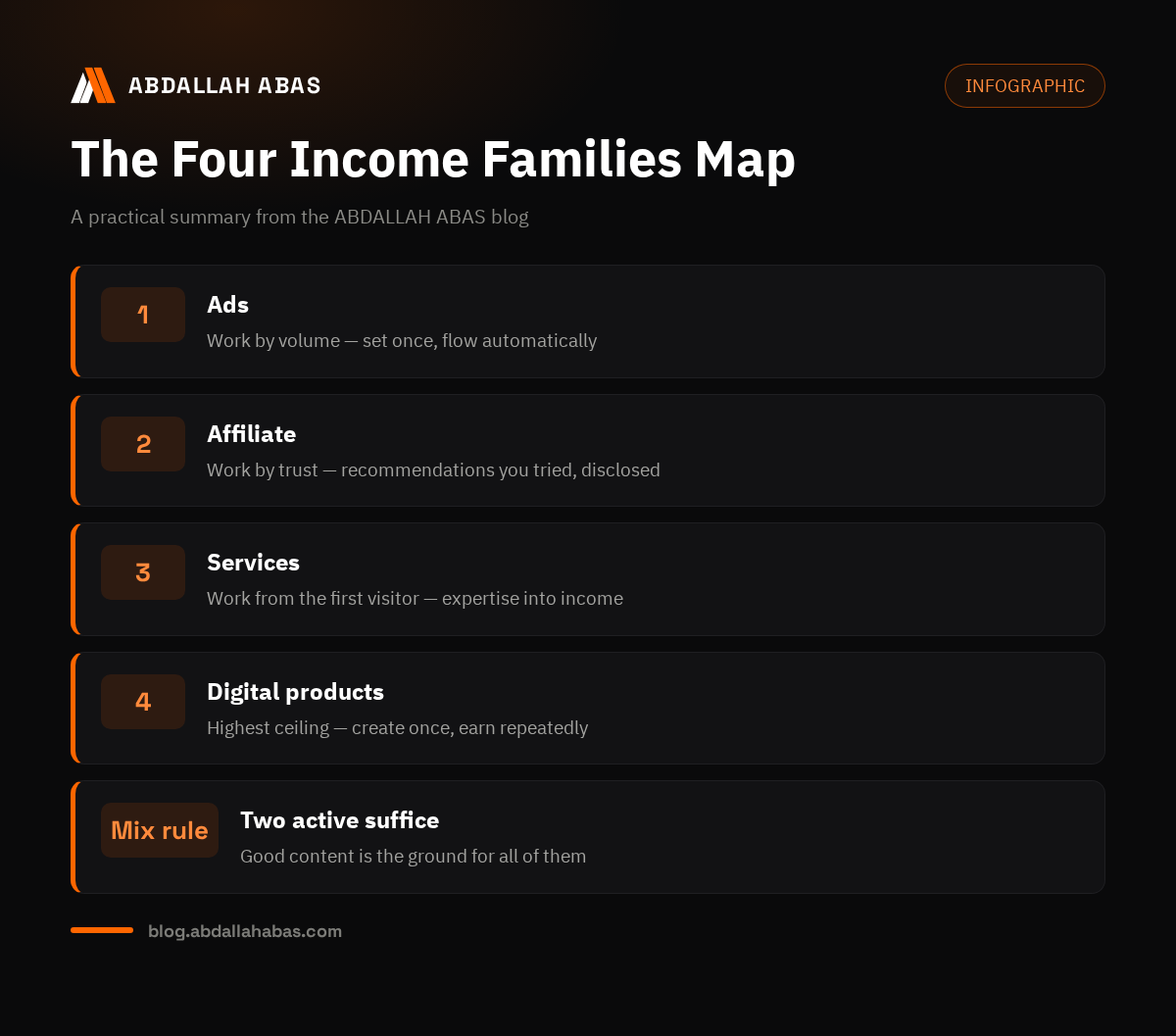
The blog income map holds four families: ads selling attention and working by volume; affiliate selling recommendations and working by trust; services selling your expertise and working from the first visitor; and your products selling your production and working by a mature audience. The mix rule: two active sources beat four sleeping ones, and good content is the ground all families stand on without exception. Define your stage honestly, choose your next source sized to it, and write your decision with a review metric.
Coming parts detail each family with a full method starting with affiliate — its company-selection criteria and honest review writing — building on the scheduling discipline of the monthly content plan and the clean-traffic foundations of the invalid traffic guide, so your mix grows on ground you already control. — company-selection criteria and honest review writing; follow them in order and your site ends the series holding a mix resisting any single source's fluctuations.
Comments