
A Monthly Content Plan: How to Decide What to Write Before You Sit Down

Most blogs do not fail from weak writing but from absent decisions: the owner sits down to write, stares at a blank page, hunts for an idea at the last minute, and picks the weakest available topic with the weakest preparation. A monthly content plan solves this problem at its root because it moves the decision moment from writing time to planning time — when your head is calm and you can see what your blog actually needs. In this article I build a complete monthly plan with you step by step, the same way I arrange client content calendars, from direct experience with blogs that went through the same confusion you are in now.
What you will actually do after reading this article:
- Choose your month's topics from data, not from the mood of a moment
- Mix article types so they serve all your goals, not one
- Schedule a publishing pace that sustains you without burning you out
- Measure the month's results and turn them into next month's decisions
Why the Write-on-Demand Method Fails
A blog depending on daily inspiration runs a tiring circular pattern: two weeks of enthusiastic publishing, then two weeks of silence, then a guilty late return producing rushed articles. The problem is not willingness but the definition of the work itself — writing is a decision to execute, not a decision to make in the same moment. When you sit to write without knowing your topic, you are doing two jobs at once with lower quality in both, and that is the origin of the fatigue every intermittent writer feels.
The monthly plan separates the two jobs and gives each its right: one planning session at the start of the month deciding topics and reasons, then writing sessions executing a ready decision rather than hunting for one. The output difference is not small — an article written from a plan points from its title to its paragraphs to a clear goal, while a spontaneous article wanders between ideas that never meet. More importantly, the plan protects your psychological consistency: when inspiration fails you one day, you do not break, because you never needed it.
Before Planning: Define Your Audience and Topic in One Sentence
No plan works on a vague purpose, so start with one honest definition sentence: my blog helps someone achieve what through what. An example from my own blog: it helps new site owners build sites that pass AdSense approval and rank in search, from direct experience without fake promises. This sentence later becomes a filter for your ideas — any topic not serving the sentence leaves the list without a long debate.
Your current situation is part of the equation too, because an honest plan knows its resources: how many hours weekly you can actually commit in your worst busy week, not your best one. This resource accounting sets your realistic pace, and a realistic pace surviving four months beats a perfect pace collapsing in month two. Write the number honestly and adopt it — a plan exceeding your capacity hurts twice: in article quality and in your relationship with your own blog.
Step One: Collect Ideas in One Brainstorming Session
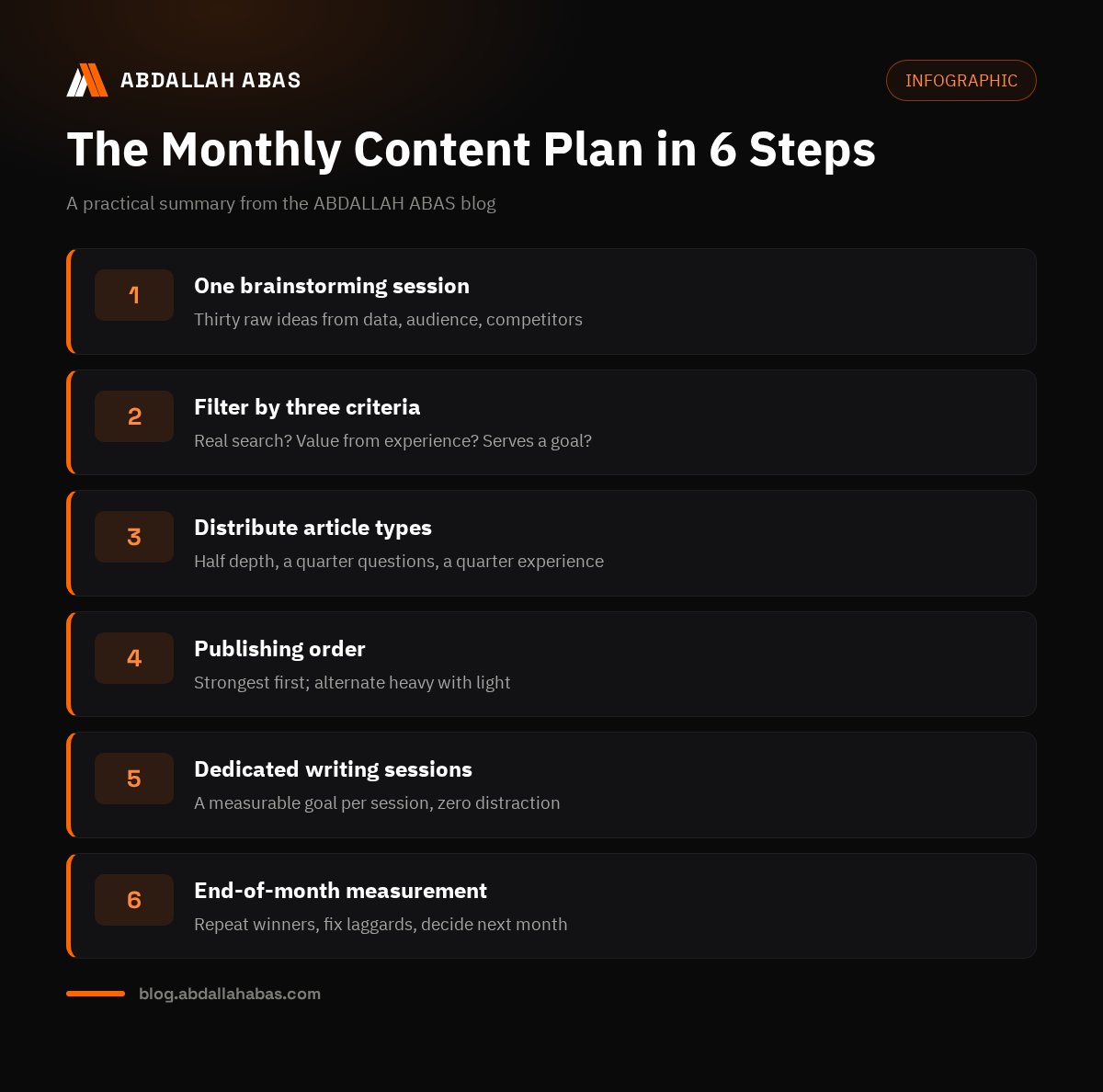
Dedicate a single brainstorming session at the end of the previous month, and record every idea without filtering: questions from visitors or comments, topics competitors covered superficially, skills you recently learned that deserve explanation, and mistakes you made that could save others. Write thirty ideas or more with no judgment on quality at this stage — the session's goal is raw quantity, and sorting comes later with a cold mind.
Then add a golden source many writers overlook: Search Console data from your published articles — every query your site shows for at a late position is a ready supporting-article idea. Gather audience questions from your niche's communities and from Google's search suggestions too; these are topics your audience searches in their language, not yours. After the session you have a rich raw list, and now sorting begins with clear criteria.
Step Two: Sort Ideas With Three Criteria
Pass every idea through three decisive questions: does my audience actually search for this even in different wording? Can I add real value here from my experience, not from retelling? Does it serve a blog goal — search ranking, trust building, or turning a reader into a customer? The idea answering no to any question leaves the list; the idea answering no to two leaves immediately — medium articles are the most expensive things you can write, consuming full time while achieving nothing fully.
What remains after sorting is usually a short list of four to eight strong ideas, which is completely normal on a small site and not weakness. Write next to each idea the primary keyword it carries and the intent it addresses — this line accompanies the article until publication, defining its title and structure. If you need a deeper method for choosing keywords themselves, see the keyword research article, which covers this stage fully.
Step Three: Distribute Article Types Consciously
The common mistake after sorting is pushing every article into one type, building a blog that is all definitions or all news with no depth or attraction. Distribute the month across three main types: in-depth articles building your authority on a specific topic and targeting competitive keywords; shorter question-answer articles capturing long-tail visits and explaining details beginners ask about; and experience articles giving your blog the personal voice nobody can copy. The practical ratio I keep: half the month depth, a quarter questions, a quarter experience.
This distribution serves SEO and readers together — depth articles bring rankings, question articles bring early-stage visitors, and experience articles build the trust turning a visitor into a follower then a potential client. Review your archive monthly and confirm the distribution has not drifted: a blog filled with one article type gradually fails to answer its audience's graduated needs, losing what distinguishes it from content farms.
Step Four: Set the Publishing Order Within the Month
Article order within the month is not random — start with your strongest depth article in the first week while your energy is full, then distribute the rest alternating heavy with light, never stacking two long articles in one week. Connect each article to a related previous one so every new piece gains immediate internal links; a blog publishing in a connected way builds a strength network serving everyone, and I detailed this network in the internal links article.
Consider your niche's seasonality too: some topics peak in specific months, and starting two to three weeks early puts you in the right place before demand peaks. A simple one-page table suffices: week, article, type, primary keyword, status. This simple table is all the tooling you need at the start — no complex management systems consuming time reserved for writing itself.
| Week | Article type | Main purpose | Example |
|---|---|---|---|
| First | Depth | Ranking and competitive keywords | A comprehensive guide on a core topic |
| Second | Experience | Trust and personal voice | A lesson learned from a real mistake |
| Third | Questions | Long-tail visitors and beginners | A common question answered clearly |
| Fourth | Depth or support | Consolidating the month's strength | An article supporting the first with an internal link |
Step Five: Write in Dedicated Sessions, Not Fragments
A good plan fails when executed in scattered times full of distraction — set fixed writing sessions in your week and close everything that is not the current article during them. One focused two-hour session produces more than four scattered hours, because the re-focus cost of every interruption silently eats your time. Preparation work like collecting sources and screenshots should be a separate task a day or two before: the writer who sits with materials ready writes at double speed.
Commit in every session to a measurable goal: a complete article or a publishable half-article, not the illusion of "working on the article" stretching two weeks without output. If your flow stops mid-session, move to another section of the article instead of holding onto the blocked one — section order is free, not sacred. Small regular habits carry the blog across months, not one enthusiasm wave evaporating at the first obstacle.
If you are building your archive from zero now and want a wider view of the blog plan from the first article, see the first thirty posts plan from the Road to AdSense series — it completes this monthly plan with a full-range map and a logical topic sequence making every month build on what came before, instead of random scattering.
Step Six: End-of-Month Measurement and Next Month's Decisions
At each month's end open your reports and collect three answers: which planned article achieved the highest search impressions, which achieved the highest clicks relative to impressions, and which held your visitors longest. The winners of each criterion are explicit signals of what your audience wants — repeat their success next month with adjacent topics, and improve or rewrite what did not move. Measurement needs no complex dashboards; one sheet with four columns does the job.
With this the cycle completes: plan, execute, measure, then plan smarter. After three months of consistency you will see patterns you could never guess: topics your audience prefers beyond expectation, article types that always fail despite their beauty, and publishing times fitting your audience specifically. This accumulated knowledge is the real capital of a consistent blog — what separates slow steady growth from the constant wobbling that kills new site owners' enthusiasm.
Your Old Archive Is Part of the Plan Too
Most content plans look forward only, forgetting your old archive is an asset needing periodic maintenance. Reserve a fixed slot in your monthly plan for updating one or two archive articles: reviewing outdated information, adding new experiences since publishing, and improving the title and description if the article struggles in results. An updated article regains a position it once held at far less effort than building a new one, and the update date itself is an honest signal to Google that the site is alive and cared for.
Pick each month's update candidate from your data: an article that ranked then declined, one receiving impressions with few clicks, or an old article pointing to changed pages. Add a fresh internal link from the update to your newest article, so the archive interlocks with current work instead of staying an isolated island. This habit preserves the value of everything you wrote before, and tells search engines your quality standard is permanent, not a passing event.
Post-Publish Promotion Is Not Optional
A good article nobody knows exists is a message never sent — add a mini promotion plan for every article happening on publish day itself: shares on your social accounts worded differently per platform, sending to your email list if you have one, and mentioning it in communities where you are active, respecting their rules. Promotion does not raise ranking directly, but it delivers the article to its first real readers, and those may share it and add rare external mentions serving its ranking later.
A working practical rule: connect every new article to three real promotion channels written into the plan itself — a plan that writes promotion in the last line is the plan that forgets it. And remember a plain text share appending the link is not enough; platform-appropriate compelling wording changes results considerably. Review promotion impact a week after each publish: which channel brought actual clicks deserves bigger investment next months, and which was not worth the effort at all.
A Full Week Model Inside the Plan
To make the plan concrete, here is a model week for a small site at two articles weekly: Sunday, a half-hour session reviewing the schedule and preparing both articles' materials; Monday, a focused writing session for article one; Tuesday, proofreading and publishing with mini promotion; Thursday, a writing session for article two; Friday, publishing and promoting it plus a quick review of last week's article's performance. Remaining days stay open for your main work without writing guilt hanging over your head — itself a psychological benefit worth the whole plan.
The model is adjustable to your available days, and what matters is not the exact days but a defined slot for every task: a task without a slot in your week never happens. Write the schedule where you see it daily, and make commitment easier by reducing sacrifice — a half-hour session before writing saves an hour inside it, and a short post-publish review catches problems before accumulation. This is how a plan turns from a document into a habit, and habits alone carry blogs to their place.
Common Mistakes in Content Plans
The first chronic fault is a perfect on-paper plan exceeding its owner's capacity by a hundred percent, collapsing in week three and generating a failure feeling hard to shake. The second is the rigid plan with no room for emergencies — a timely topic appears mid-month and the whole plan collapses instead of swapping one article. The third is the plan never measured: months producing articles nobody reads because their data was never read.
The common final step into failure is mixing the plan with momentary enthusiasm — a random article outside the plan breaks the sequence, outrunning planned articles that mattered more. Practical rule: any urgent idea goes into next month's list and publishes only if it is a seasonal opportunity about to lapse — and then it swaps an equal-weight article rather than canceling the plan. Discipline here is not personal harshness but protection for your blog's quality across months, not just a day.
Questions First-Time Planners Ask
How many articles monthly is the right number?
The right number is the one you can repeat at your best quality, even if only two at the start. Two monthly for a year builds a strong archive of twenty-four good articles, while eight monthly for two months then stopping builds eighteen average articles never completing their depth. Start below what you expect you can do, raise the pace once your routine proves it can bear the increase — gradual climbing beats repeated collapse.
Should I write in series or standalone articles?
Series are strong for SEO and follow-up reading, but they place an obligation on you — a five-part series must complete even if it stretches months. Practical rule: fill your plan mostly with standalone articles and add just one series managed carefully; once started, make it a priority every month until it completes. Blogs opening many series without completing them collect unfulfilled promises, weakening the trust of readers who followed them from the start.
Should I use AI tools in my writing?
Use them for preparation assistance: gathering common questions, suggesting titles, reviewing language — tasks improving efficiency without creating your value. But writing the full article with AI produces a text without real experience, exactly what Google targets under its low-value content standards. Your value is your experience, opinions, and tested examples — any tool that shortens this balance shortens your blog with it.
Should I plan the whole year at once?
Complete annual planning is an intellectual trap — one year carries changes nobody can predict: your priorities shift, new topics appear, and your data slaps your plan hard. The practical error is a general intellectual plan for the year naming main directions, then detailed monthly plans descending from it. This keeps the general direction while avoiding early decisions turning stale after two months — the detailed monthly plan is the one actually respected.
How do I balance new articles with updating old ones?
A practical rule succeeding with small blogs: make the criterion archive size. When your new articles are few against demand, devote the month to adding with almost no updating; when the archive matures, make updating half the plan. The important thing is that updating be a planned data-driven decision, not random repair eating writing time — each serves a completely different goal in the blog's growth journey, and both need conscious, not random, distribution.
When do I adjust the plan mid-month?
Adjust for a stated reason, not a passing mood: a seasonal topic useless later, an important industry news deserving immediate coverage, or illness or an emergency shrinking your time. In each case swap one article for an equal one and keep the month's structure — do not cancel the plan entirely. And record your adjustment with its reason, because the end-of-month review needs to know what actually happened against what was planned originally.
Conclusion: The Early Decision Is Half the Quality
A monthly content plan is not organizational bureaucracy but a method protecting your quality and consistency from mood and time fluctuations. One brainstorm, sorting by criteria, type distribution, publishing order, dedicated writing sessions, and monthly measurement — six actions turning your blog from an intermittent project into a system accumulating age with every month.
The early decision is genuinely half the article's quality: whoever decided their topic, goal, and angle is in a stronger position than whoever starts from a blank page, and the other half is execution honesty showing in every paragraph. And if you want someone to execute this plan for you or build it with you sized exactly to your blog, that is my content writing service, delivered by this article's own standards.
Comments