
SEO Foundations (3): Keyword Research — A Complete Method for New Sites

We reached the stage where knowledge becomes a working schedule: keyword research. After understanding how the search engine works and how to read any search's intent, you now need an organized method turning that ability into an ordered topic list feeding your coming months with confidence. This part delivers a complete method relying on free tools alone, designed specifically for new sites that cannot beat ancient giants on broad keywords — you learn choosing keywords you can actually win, then expanding smartly as your site grows.
What you will do in this part:
- Generate a keyword idea list from multiple free sources
- Filter keywords by competition, intent, and fit for your site
- Build an ordered article list ready for a monthly plan
- Avoid keyword-selection mistakes wasting months of writing
Where Keyword Ideas Come From: Five Free Sources
Start generating from five sources completing each other. First, Google's own suggestions: type your topic in the search box and read the dropdown suggestions plus the "related searches" section under results — this is your audience's actual language, recorded from millions of searches. Second, the "people also ask" box revealing side questions around your topic, each question a candidate standalone article. Third, your niche's communities and groups where people ask in their natural language without wording constraints — the most honest ideas possible, being declared need, not guessing.
The fourth source is your competitors: open the sites ranking above you and read their titles and topic sections — you are not copying their articles but discovering the topic map they serve, then asking: which gaps did they leave? Which angles did they miss? The fifth source, the most precious for an existing site: the performance report in Search Console — every query your site shows for at late positions is a ready supporting-article idea your audience discovered for you. Gather from these five sources a raw list of fifty ideas or more before any filtering; raw abundance is the condition of a good final list.
First Filter: Narrow the Keyword Until Its Intent Matures
Pass the raw list through the intent filter you trained on in the previous part: every ambiguous keyword gets specified or struck. "SEO" alone is broad and ambiguous; "how to add my site to Google" is a mature, clear intent ready for work. This narrowing is called long-tail targeting — keywords of three words or more with smaller volume, lighter competition, and more precise searchers — the natural ground of new sites, on which reputation is built before attacking broad terms.
The practical narrowing rule: add to every broad keyword one natural specifier — who, for whom, under what condition: "SEO tools" becomes "free SEO tools for Arabic blogs"; "online earning" becomes "earning from a static blog without investment." Every specifier lowers competition and purifies the reader. Whoever fears losing volume by narrowing should remember: a site with no ranking holds no volume at all — winning a small keyword beats losing a big one.
Second Filter: Measuring Competition With a Realistic Eye
After intent narrowing, measure competition by reading the results page, not tool numbers: among the first ten results, how many strong ancient sites do you see? Do forums or weak pages appear among them? Are the winning titles old, unupdated for years? If results fill with big sites' fresh articles, postpone this keyword; if you spot gaps — weak, old, or shallowly-covered results — this is a winnable keyword now. This manual evaluation outperforms any tool's accuracy because it reads reality, not estimates.
Use approximate numbers as a complement, not a judge: Google's Keyword Planner gives free approximate monthly volume with an ordinary account, and free browser extensions show quick estimates while browsing results. The golden rule: the number only excludes completely dead keywords with no search — it never decides the win. A small-volume keyword you beat successfully overflows your site with more traffic than a big keyword swallowed by competitors' seniority.
Third Filter: Fit for Your Site and Stage
A keyword sound in intent and competition remains conditional on fitting your site: does it serve your blog's core topic? Can you deliver real value there from your experience? Does it serve a goal — ranking, trust, or conversion? A keyword where you cannot answer better than competitors, however easy, is a trap consuming a full article into a result neither reviews nor visitors will trust. Fit also means gradation: a new site starts with rare, precise-intent keywords, graduating toward broader ones as authority accumulates.
Connect the third filter honestly to your site's stage: a ten-article site does not attack keywords needing years of authority, but wins every precise keyword it treats with unavailable depth. Collect on one sheet per surviving keyword: the keyword itself, its intent type, your estimated competition from weak to medium, and the article idea serving it. This sheet is your true planning asset — its keyword count is not a goal but a result: five studied keywords are richer than fifty raw ones.
| Criterion | The question it asks | The decision |
|---|---|---|
| Intent maturity | Do I know who searches and what they want? | Specify the keyword or strike it |
| Competition | Do gaps exist in top results? | Fill them or postpone |
| Volume | Does anyone actually search? | Exclude the dead only |
| Fit | Can I beat competitors from my experience? | Write it or leave it to others |
From List to Publishing Plan: Ordering Priorities
The surviving keyword list needs ordering turning it into a work schedule: start with the lowest-competition, clearest-intent keywords — your first victories, building an effective index and early systemic trust. Group topic-near keywords into clusters: keywords circling one topic are served by an internally-linked article series strengthening each other instead of competing. Then distribute your clusters across months, each month completing one central topic.
This ordering turns keyword research from theory into your content plan's engine: every article in your schedule knows its keyword, intent, and the gap it fills before writing a single line. I placed the monthly distribution's practical details in the content plan guide — merge this method with it and you hold a production system knowing why it writes every article before starting, the difference between a blog building ranking and a blog publishing hope.
Keyword-Selection Mistakes Wasting Months
The first and most expensive: chasing broad keywords from a new site — months of writing wasted in a pre-decided race that could have filled dozens of winning precise keywords. The second: writing the article first then hunting a keyword after — reversing the whole method and producing articles backed by no real search. The third: relying on a volume number alone without reading results and intent — the writer is surprised that a beautifully-numbered keyword faces unbeatable sites. The fourth: neglecting the performance report later — keyword research is not a one-time event but a cycle renewing from your site's own data.
A fifth, subtler but common mistake: repeating one topic under similar keywords in separate articles — your articles compete with each other, weakening everyone. The solution crossing with the previous part: check intent before writing — if two keywords answer the same question, merge them into one stronger article; if intents differ, separate the two pages clearly. With this balance you build an archive where every page holds a unique position, no internal wars.
Your Audience's Language Before the Experts': The Principle Deciding Every List
A repeated keyword-selection error: writing in experts' language while the audience searches in their daily tongue — writing "page performance optimization" while people search "speed up my site," or "cloud hosting" while the audience types "cheap website hosting." The linguistic match between your article and your audience's search is the meeting condition: the system links page to search through language first, and the beautiful synonym nobody searches is a dead word however precise.
Extract your audience's language from its honest places: their question titles in communities, their comments on competitors' articles, the search suggestion forms they type with their typos and abbreviations. Then use their language in your titles and article preamble without fabrication — whoever searches in their own language finds themselves instantly upon entering your page: that sense of linguistic response is the first impression proving this page was written for them, not for an algorithm.
The Free Tools in This Method: Where Each Sits
Arrange tools along the method's stages so you do not scatter: at generation, Google's suggestions and the questions box and your niche's communities work with you — no account, no subscription. At estimation, Google's Keyword Planner with an ordinary account enters, plus a free extension showing estimates while browsing, and Google Trends reading the keyword's seasonal curve. After publishing, your Search Console performance report becomes the first tool feeding the coming keyword cycle.
Do not assume free tools' absence means precision's absence — the difference between free and paid at this stage equals a good map versus an advanced telescope: the map gets you there; the telescope decorates the road. Tie any tool purchase to concrete limits you face in work, not to ads promising superiority — I arranged the full free kit in the creators' tools guide, with tools I actually use in this very article's method.
Your Keywords Sheet: How to Record and Manage It
Your keywords sheet is a living work tool, not an archiving file — give it a fixed structure in Google Sheets: a column for the keyword in its final specified form, intent type, competition estimate, the linked article idea, status from idea to written to published, and a notes column documenting your results-page readings. These seven columns turn your list from scattered text into a management board showing instantly what is coming, what published, what waits.
Review the sheet monthly in your planning session: add new keywords from the performance report and communities, update published statuses, move completed ones into coming months, and log seasonality beside every affected keyword. The updated sheet grants you your site's institutional memory: return to it a year later and find why you wrote what you wrote and what opportunities remained — this decision archive is what separates a managed blog from one publishing randomly then wondering where the months went.
A Full Applied Example: From Topic to Ready Keyword
Let us run the method start to end on one topic: say your blog is in site building, and the topic "registering your site with search engines" came from repeated community questions. Open Google and type "register site in Google," reading the suggestions: "register site in Google Search Console" and "how do I add my site to Google" appear — choose the clearest intent: "how to add my site to Google step by step."
Read the top ten results: you find good Arabic guides, but three are two years unupdated, with ad-crowded layouts — there is the gap: a fresh, clean guide with steps matching the current interface fills it. Check the estimate in Keyword Planner finding reasonable volume, and decide the keyword is ready — record it in your sheet with its structure, procedural intent, and discovered gap. It became a fully-ready article idea before writing one line — exactly what this method does with every topic you meet.
Seasonal Keywords and Passing Opportunities: When to Outrun Demand
Some list keywords are seasonal, peaking at a specific time of year — these need a timing decision, not just a writing decision: read the keyword's curve in Trends to know its peak month, then schedule your article a month to two before the peak so your page is indexed and stable when demand surges. The page published on peak day meets competition at its strongest while indexing is incomplete; the one that preceded finds demand standing at its door.
Passing opportunities also deserve attention: a new product appearing in your market, a major update hitting a tool your audience uses, a question bursting into temporary interest. These grant small sites the outpacing chance because big competitors move slowly — the rule here is speed with quality: the first good guide beating the crowd harvests the whole search wave. Do not over-chase the passing at your plan's expense, but never ignore it when it crosses your expertise directly.
Linking Keywords to AdSense Approval and Earnings
Your chosen keywords serve three goals in one path: they pull visitors from search with real intents; they raise your pages' quality before reviewers because topics are treated in depth, not filler; and they build an archive displaying relevant ads to an interested reader, lifting your clicks' value. A well-chosen keyword is thus an economic decision, not a technical one: every article without a clear keyword is a page consuming publishing effort and bringing nothing.
Here this part integrates with the Road to AdSense series where we built the first thirty posts plan: that plan was designed by this very part's method — topics chosen for precise keywords with clear intents. Whoever joins the two series holds one integrated method starting from the keyword and ending with an approved site ranking in its search — the goal this entire blog was built for.
The Monthly Keywords Cycle: How Your List Grows
Keyword research is not a founding project that ends but a famous cycle renewing from three springs: your performance report revealing new queries your pages show for; your audience's communities generating new questions weekly; and your market's changes and new products manufacturing keywords that did not exist. Reserve twenty minutes in your monthly planning session for this cycle: review new queries, add the worthy to your sheet, move mature keywords into coming months.
This cycle turns your site into a self-learning system: every article you publish brings data; every data reveals keywords; every keywords generate articles — the list, index, and authority grow together in a loop that never stops. The senior competitor sites you race today built this loop for years, and you now hold the same method; the only remaining difference is the consistency turning method into an unbeatable accumulated archive.
Questions From Those Researching Their First Keywords
How many keywords do I target per article?
One article targets one clear-intent primary keyword, with secondary keywords flowing naturally from the content itself without forcing. Multiple primary keywords in one article scatter its intent and weaken its presence in every one of them, while single focus makes it a strong candidate for its keyword and its fine branches. Write the article for one question, and you will find it answering many side questions without being asked.
Are paid keyword tools necessary for seriousness?
Not necessary at your first stage, ever — they offer finer estimates and wider export, but free sources cover the full planning need: Google's suggestions, questions, competitors, your site's reports, and Google's planner for estimation. An early subscription to keyword tools often substitutes for weak confidence in the method, not for a real data gap; good spending's time comes after the site grows and free limits become tangible.
How do I know a keyword should wait?
Postpone the keyword when its top results are all ancient updated giants with no gap visible to you, or when it sits outside your real expertise, or when it needs authority you do not hold yet. Record it in a "later" sheet and revisit every few months — positions change: your site grows, competitors slack, and today's postponed keyword may open tomorrow. Postponement is a planning decision, not surrender; the postponed list is part of your map, not its neglect.
Do keywords' values change with seasons?
Yes — some keywords are explicitly seasonal, peaking in specific months like study seasons and occasions, and others shift with market changes and new products. Use Google Trends to read the keyword's curve across months, precede seasonal keywords by weeks so your page stands ready before the surge, and log seasonality beside each keyword in your sheet to plan its publishing at its right time annually.
Part Three Summary
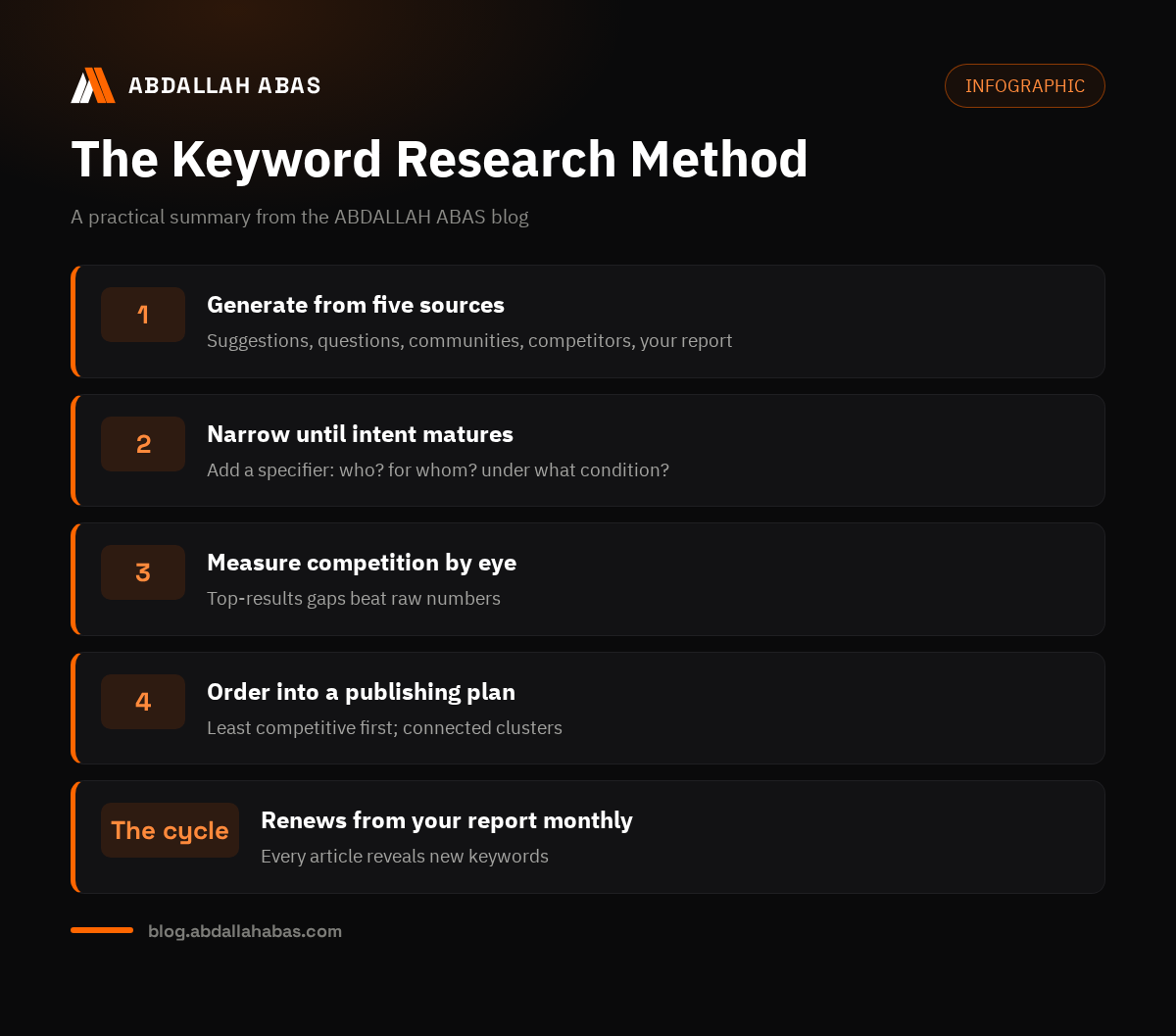
Keyword research is a four-stage method: generation from five free sources; narrowing until intent matures; competition measuring by reading results, not single numbers; then ordering into a publishing plan of connected clusters. Whoever applies this method writes every article knowing its reason, keyword, and gap; whoever neglects it publishes in darkness wondering at absent results.
The four stages work in order and never skip: generation without narrowing produces an unfocused pile; narrowing without competition reading produces losing fights; and competition reading without ordering produces a list that never becomes a schedule. Apply the method to your first ten keywords this week, and build from them a monthly list serving you for months — with your performance report, the method turns into a self-growing cycle. With this part the foundations trilogy completes: how search works, what the searcher wants, and which keyword deserves your article — after it, the series' parts move into detailed applications from titles to links.
Comments