
SEO Foundations (2): Search Intent — The Key Deciding Which Page You Write and How
In the previous part you understood the search engine's three stages, and we now reach the concept separating an article that ranks from one lost on page seven despite beautiful writing: search intent. Intent is the real question hiding behind the words a searcher types into the box — what the system tries hard to match between page and searcher. Whoever writes about a keyword without understanding its intent writes an answer to a question never asked; whoever understands intent writes the page the searcher wanted before typing the search. In this part we dissect intent's types, reading methods, and article alignment, with practical steps for every coming article.
What you will do in this part:
- Recognize intent's four types and spot each type's signals
- Read any keyword's intent from Google's results page within minutes
- Align your article's title and structure with the discovered intent
- Fix old articles serving the wrong intent and losing rank
What Search Intent Is and Why It Is the Core of Matching
When someone types "AdSense" into Google they do not want a dictionary — they may want a quick definition, the signup process, or why their application was rejected, and the keyword alone reveals none of these. The system infers intent from the searcher's context and history and the patterns of millions of searchers before them, then orders results by estimated intent. So it is not enough for your article to be about the topic — it must be about the topic from the exact angle people actually search at that keyword.
Matching here is a two-sided process: the searcher's intent and the page's intent as the system understands it. A page carrying the keyword in its title but answering a different intent loses to a weaker-written page perfectly matching intent. Whoever understands intent spares themselves a losing race: they do not fight for a keyword whose intent they do not serve — they choose the keyword fitting what they already have. This thinking shift from word to question is this part's first and most important fruit.
The Four Types of Search Intent
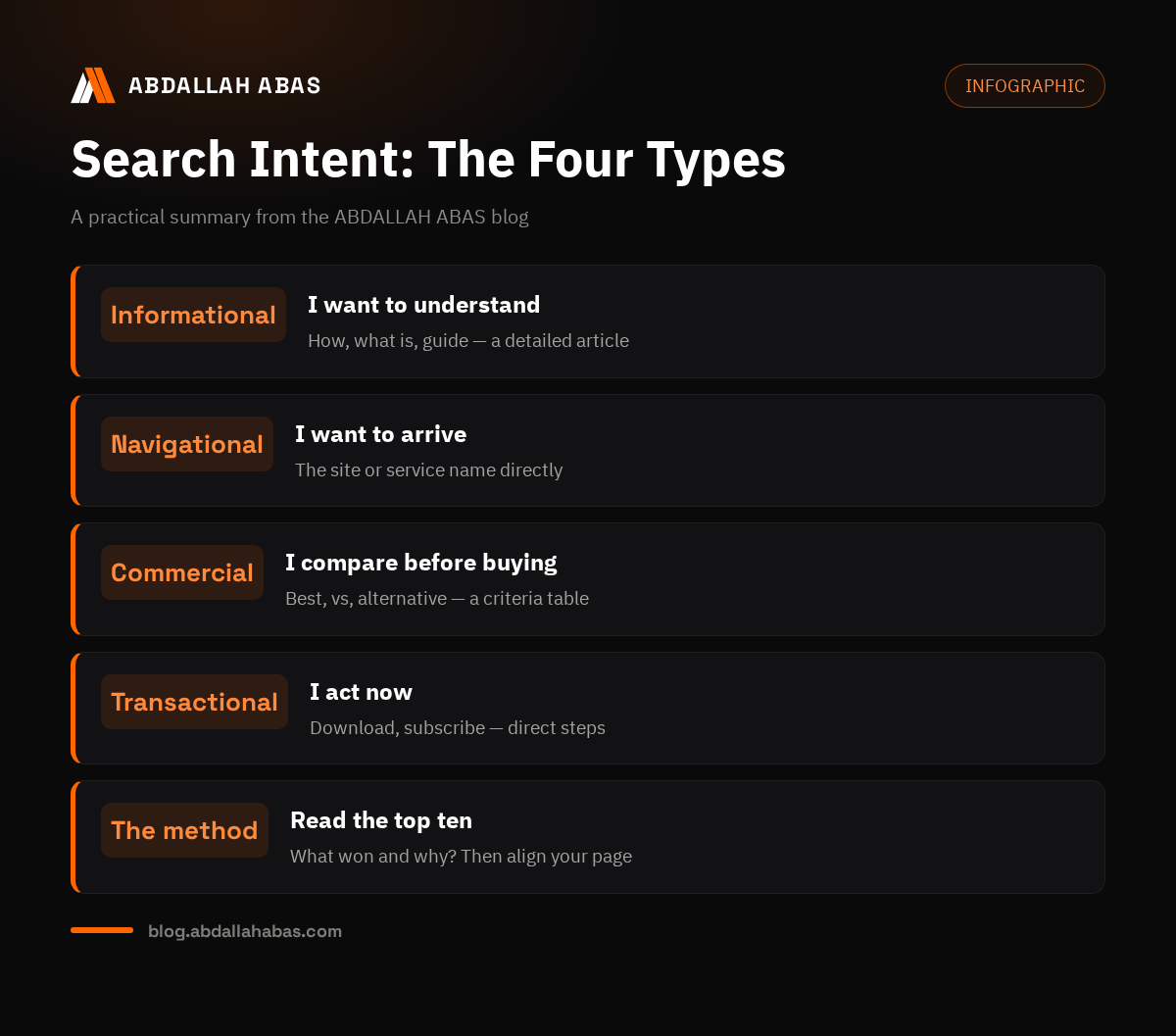
Intent classifies into four types covering practically every search. Informational: the searcher wants knowledge or explanation, marked by words like "how," "what is," "guide" — the widest type for content sites. Navigational: the searcher wants to reach a known site or page, typing its name directly — rarely serving new blogs except for their own name. Commercial: the searcher evaluates before buying, marked by "best," "comparison," "review" — the most commercially valuable. Transactional: the searcher is ready for a specific action like downloading or subscribing, marked by explicit immediate verbs.
Distinguishing these types is not classification luxury but the content decision itself: a step-by-step practical article serves informational-procedural intent; a comparison article serves commercial; a comprehensive definitional page serves broad informational. Each type has its fitting page structure, proper length, and different result shapes in Google — mixing them writes an article whose length and structure fit nobody, losing ranking regardless of content quality in itself.
| Intent type | What the searcher wants | Language markers | Best page shape |
|---|---|---|---|
| Informational | Understanding, explanation | How, what is, guide | Detailed step-by-step guide |
| Navigational | Reaching a specific site | Site or service name | Clear official page |
| Commercial | Comparison before purchase | Best, vs, review, alternative | Comparison article with criteria table |
| Transactional | Performing an action now | Download, subscribe, sign up | Direct action page without distraction |
How to Read Intent From the Results Page Itself
The easiest way to know any keyword's intent is asking Google itself: type the keyword and examine the first ten results with an analyst's eye, not a reader's. What type are the winning pages — long guides, comparison articles, videos? What do the titles share? Do special boxes appear — common questions, prices, direct steps? All these signals tell you the intent the system settled on for this keyword: it tested millions of pages and reached this mixture, and whoever reads the results reads the free summary of that testing.
Then examine the top titles for the language searchers express themselves in: do titles carry numbered steps? Do they promise "for beginners"? Do they stress the current year? This winning language is the audience's voice written down — your new article should address it without copying it literally, because literal copying drowns you in the crowd while conscious alignment distinguishes you. Ten minutes on Google's results save you weeks of writing in the wrong direction — the cheapest intent research you can run, completing the data your own reports show as explained in the Search Console guide.
Aligning Your Article With Intent: From Title to Structure
Once intent is identified, two decisions reflect it immediately: the title and the structure. The title declares the intent it serves — an informational article starts with "how" or "guide"; a comparison article declares "best" or pits two named options against each other. Structure follows the searcher's expectation: the informational searcher wants a quick definition upfront then ordered detail; the comparing searcher wants the comparison table early, not after a thousand words; the transactional searcher wants steps directly, with no long preamble blocking their goal.
Remember alignment includes coverage scope too: broad informational intent needs comprehensive coverage of main aspects in one deep article, while a narrow precise intent is served by a focused, relatively short page solving one question without filler. Whoever widens a narrow article scatters their reader; whoever narrows a broad one leaves the searcher's questions unanswered, sending them to a competitor. Intent defines the whole offering: length, structure, depth, language — which is why it is the first decision made before the first written line.
Dual Intent and Multi-Meaning Keywords
Some keywords genuinely carry multiple intents — "AdSense" is a clear example: definitional, procedural, or commercial depending on who searches. Facing such a word, do not choose intent from your head — look at results distribution: if comprehensive guides dominate, the ruling intent is broad informational; if results mix definitions with tools, intent is split and each half needs a more specific keyword. The ambiguous word is not an opportunity for everyone but a trap for whoever writes without reading; the professional narrows their keyword until its intent becomes one and clear.
Add to the keyword the specifier distinguishing your audience: instead of "AdSense," write "AdSense approval requirements for Arabic sites" or "increasing AdSense earnings in a tech niche" — every specifier raises intent clarity, lowers competition, and brings you closer to a reader who actually needs what you have. This deliberate narrowing is what we call long-tail targeting, and we dedicate a full methodology to it in part three of the series with tools and criteria — it is the core strategy of new sites racing sites years older.
Fixing Old Articles Addressing the Wrong Intent
Knowing intent now lets you diagnose your old articles: open your performance report and pick an article appearing for queries unrelated to its actual topic — a signal the system is confused about your page's intent — or one with many impressions and few clicks — a signal your title promises an intent the page does not fulfill. In the first case, narrow the page's topic toward one clear intent; in the second, fix the title and description to promise what the article actually delivers. Both fixes revive old pages the system had started ignoring.
Beware the reverse fix: an article succeeding at one intent tempts you to add other topics widening it, scattering its intent and losing its original ranking. The rule: one page serves one intent clearly, and expansion happens through new connected articles, not by stuffing the successful one. Applying this rule across your whole archive lifts your site's performance without writing a single new article — among SEO's cheapest and most neglected improvements.
Intent and Post-Click Experience: Why the Searcher Leaves Fast
Alignment does not end at the click — it starts there: the searcher arriving with specific intent evaluates your page in seconds — is this what I wanted? Their answer's indicators are behavioral signals the system reads: dwell time, returning to search results, no page interaction. The page matching intent keeps its visitor and completes their mission; the page whose title tricked the intent is abandoned quickly, the searcher returns to results, and the system logs that return as a mismatch mark — the page declines over time despite its apparent optimization.
So test your page yourself as a real searcher: search your keyword, enter your page, and honestly ask: did I find the answer within ten seconds? Does the shape and structure serve my intent type or the writer's taste? Whatever makes you feel lost or delayed will make others feel it multiplied — the system holds no feelings but holds millions of behavior examples translating those feelings into ranking signals.
Intent in Images, Video, and Special Results
Today's results page is not text links only — it mixes images, videos, question boxes, and direct snippets, and each shape's position in results tells you the system's preferred answer format. A keyword bringing videos to the top says the searcher prefers watching over reading; a keyword showing common questions says the intent carries side questions the searcher expects answered on the page itself.
Use these signals in building your page: add a FAQ section when questions appear in results; add explanatory images when images appear beside results; consider a companion video when videos dominate the top. This comprehensive alignment makes your page a candidate for more than one result shape simultaneously, expanding your screen presence without competing against yourself.
Linking Intent to Your Monthly Content Plan
This knowledge pays when it enters your working plan — make intent-reading the first step in choosing every article: before adding a topic to your schedule, read its keyword's intent from Google's results, identify its type, and compare with your existing articles. This two-minute check prevents topic duplication under different intents, filters your articles before writing rather than after, and saves you hours rewriting an article written from the first line in the wrong intent.
If you run your plan on a cyclical method, this check enters the monthly brainstorming session explained in the monthly plan guide: intent becomes a sorting criterion beside the three usual standards, and no topic passes to the schedule without a clear answer — which intent does it serve? Who does it address? With which structure? This turns theoretical knowledge into a quality gate every article passes through.
Practical Examples: From Keyword to the Right Page
Take three real keywords through the full method. First: "increase AdSense earnings" — results show tips articles and improvement lists: an informational-procedural intent mixing explanation with application; its winning page starts with principles then orders practical improvements by impact, addressing someone with an already-approved site, not a beginner not yet approved. Second: "best free SEO tools" — results are comparison lists with tables: clear commercial intent; its page needs selection criteria and explicit free limits, not a tutorial.
Third: "how to index my website" — results are step-by-step guides and short videos: pure transactional-procedural intent wanting immediate execution; its page starts with steps directly after a very short preamble, adding a FAQ section for expected obstacles. Note that all three keywords sit in one field, yet each led to a differently-shaped, -lengthed, and -worded page — this is the method's essence: the keyword defines the page, not the reverse; whoever writes a page then hunts a keyword works backwards.
Intent and Audience: For Whom Exactly Are You Writing?
Intent alone does not suffice — one keyword brings audiences of varying expertise, and beginner searchers differ from advanced ones in what satisfies them. Determine your keyword's audience level from the winning results' language: do titles explicitly address "beginners"? Do explanations define terms or assume them? If results address beginners and you spot a gap in advanced content — or the reverse — that is your distinguishing opportunity: address the neglected group with higher quality than available, taking a less competitive, more valuable position.
This audience clarity reflects in every page detail: defining terms at first mention, examples at the reader's level, technical depth scaled appropriately. A page addressing the right audience at the right level achieves double matching — question intent and level intent — and the system reads both from visitor behavior; whoever neglects level loses the visitor's stay even with correct intent. Keep two questions in mind before every article: what does this searcher want? And at what expertise level do they want it?
A Pre-Publish Intent Checklist
Make this list a closing habit for every article before publishing: did I read the results page for my primary keyword and know its intent type? Does my title declare the same intent showing in results? Does my structure fit the type — steps for procedural, table for comparison, early definition for informational? Does my language level match the keyword's audience? Did I answer the side questions appearing in the "people also ask" box? Does my page fully deliver what its title promises without over-promising?
Run the list in five minutes on every article, fixing gaps before publishing rather than after, and keep it in your notes as part of your publishing routine beside the technical checklist. This small discipline separates a site whose articles are all designed for real questions from a site whose articles are personal writing exercises — the difference shows in numbers within weeks of consistency.
Common Intent Mistakes Sinking Good Articles
The most famous mistake: writing a comparison article for a keyword whose intent is informational — your page appears among comprehensive guides and vanishes, not matching what the searcher wants. The second: opening with a long historical preamble for procedural intent where the searcher wants steps immediately — they bounce in seconds. The third: addressing beginners through a keyword professionals search — you attract readers who find no depth and leave, and the system reads the quick unsatisfied exit.
These three mistakes repeat because their writers write about the topic, not the question — and that precise difference is everything: the topic starts from your knowledge and breadth of reading, while the question starts from the searcher's need, language, and level, and the system rewards whoever starts from need, not knowledge. The simple check revealing the error early is one question before writing: who will search this word and what exactly do they want to find? If you can answer in one specific sentence, you are ready to write; if you stumble, you have not understood the intent yet — and ten minutes on the results page grant the missing answer.
Questions From Those Applying Intent
Does a keyword's intent change over time?
Yes — intent moves with people's behavior, events, and new products: a once-informational keyword can turn commercial after a new product carries it, and search tone itself changes with generations. Review your primary keywords' intent every few months with a quick results-page reading, and watch in your performance report the new queries your pages appear for — an early alarm that intent is shifting and needs a new page or a directed update.
Can one page serve two intents?
In limited cases yes, when the two intents are genuinely inseparable — like an explanation plus a tool for the same task. Generally mixing weakens both: the system ranks the purer-intent page. If your keyword holds two real intents, write two different pages linked to each other, letting each compete in its own arena — this separation grants each page its full chance instead of scattering both.
How do I know a query's intent from the performance report?
Open the query in Google and read its results page as explained — the query in the report is just text; intent is read from its actual arena. Also watch click behavior: a query showing often with no clicks usually means your page's intent does not match the query's — examine the results and compare them to what your page offers; the gap between them is your next fix plan.
Do category pages serve intent or only articles?
Category pages serve browsing-collection intent — a real intent mattering to crawler and visitor — but they need description and content distinguishing them from a bare link list. Articles serve informational, procedural, and commercial intents in depth, and each has its place in the structure: the category is exploration's haven, the article is the answer's station. Neglecting category pages loses a whole indexing path; building them as naked lists loses their value before the system.
Part Two Summary
Search intent is the real question behind the words — its types are four: informational, navigational, commercial, and transactional, each with its language, structure, and fitting page shape. Whoever reads a keyword's intent from the results page itself writes the page the searcher and the system both want; whoever ignores it writes beautiful articles lost in shadows. Apply the ten-minute reading method to every keyword before writing about it, and review your old articles against intent — you will find treasures restoring their ranking with a simple fix. The series' third part moves to keyword research with a complete method gathering everything you learned here into a practical tool building your coming article list.
Comments