
The Road to AdSense (10): The Review Journey — What Happens to Your Application After You Press Submit
The previous parts prepared your site mobile-first, fast, and fully checked — and now you stand at the moment where everyone's heart beats faster: pressing the submit button, then waiting for a reply nobody knows how it is made. The waiting itself is not the hard part; the hard part is waiting without understanding what happens behind the curtain, so every silent passing day becomes new anxiety and every inbox refresh becomes a habit repeated ten times daily.
In this part I open what happens to your application inside AdSense, stage by stage, the normal duration of each stage, what you should do while waiting, and how to read the reply either way — honestly, without promises and without guessing. I wrote this guide from watching dozens of applications cross the same corridor, and the pattern is always the same: informed waiting ends better than anxious waiting.
What you will do in this part:
- Understand your application's stages from first check to final decision
- Distinguish normal waiting from waiting that calls for action
- Build a healthy waiting-period agenda instead of pointless anxiety
- Read the approval or rejection reply with a clear work plan, not emotion
What Happens the Moment You Press Submit
Behind the button starts an organized chain of checks: the system first verifies your account data, your domain ownership, and the absence of a conflicting active account; then your site lines up in the review queue among thousands of daily applications. The first check is fully automated: crawlers reread your site with standards deeper than normal indexing, examining your legal pages, link structure, content density, and the match between your outward claims and your inner content. This stage decides many applications' fate before a human ever sees them — which is why preparing pages before submission matters more than anything after it.
Know that the automated check does not read your article like a human reader — it evaluates signals: do pages open fast, does navigation reach everything, is content original rather than copied elsewhere, is the site's identity complete. Everything you built in the earlier parts of this series translates here into signals the system reads within minutes, so there is no trick that passes a weak site — there is a strong site that crosses easily and an incomplete one that stalls early.
The Human Review Stage: Who Sits Behind the Decision
Applications passing the automated check reach human reviewers who actually open the site as visitors: they browse your pages, read articles with human eyes, test your links, and ask the question this whole series trained you for: does this site add anything to its reader? The reviewer does not know you and owes you nothing, and sees your site from outside exactly as a stranger sees it in the first minute — every detail you left incomplete appears to them with the same clarity it would show any visitor.
This stage is why your site reviews itself during review: you cannot hide incomplete pages from a deliberate reviewer opening menus and pressing links, nor pass an annoying mobile experience on their actual phone. The advantage is that you know this before submitting, not after: open your site with the reviewer's spirit before they open it — ask their question literally, walk through it as if you do not know it, and log every place you stumble. That is exactly what they will read if you do not fix it.
The Normal Review Duration: Realistic Numbers
The question everyone asks: how long? The honest answer: duration varies from two days to two weeks for the great majority of applications, with some cases stretching to three weeks in peak application seasons, and no guaranteed official duration exists because applications pass through differently loaded phases. What can be said with confidence: waiting under a week is very common, two weeks of waiting says nothing about your result, and silence beyond three full weeks deserves opening a support ticket from inside your account — not from a random email.
The most dangerous thing at this stage is drawing imaginary conclusions from reply speed: fast approval does not mean your site is ordinary, and fast rejection does not mean your site is bad — time here reflects system queues and reviewer availability far more than your site's quality. Prepare your mind for both outcomes, and spend the wait on work serving either, as we will see shortly, instead of translating every silent day into an early verdict on months of your work.
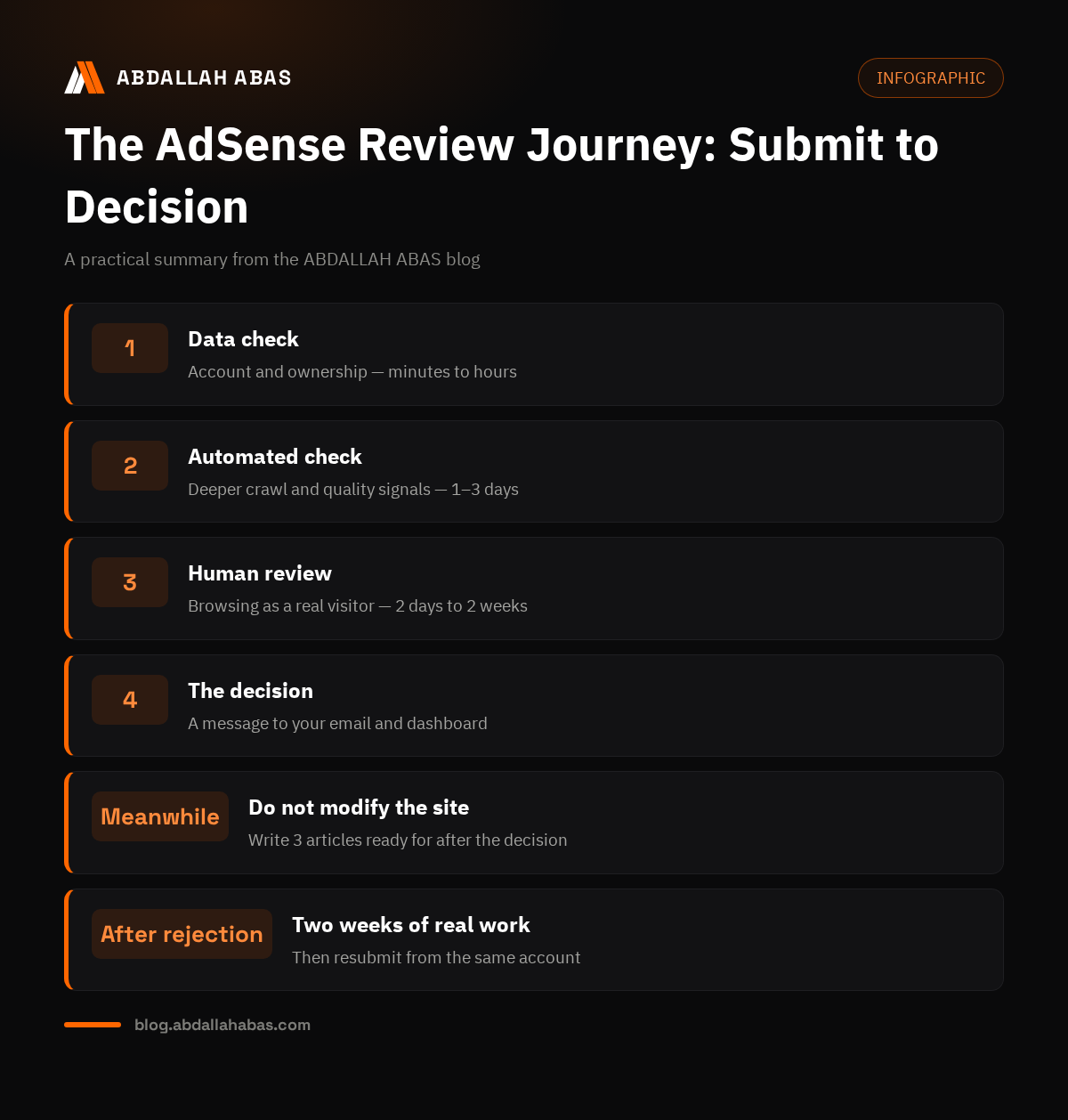
| Stage | What happens | Normal duration |
|---|---|---|
| Initial data check | Account, ownership, account compatibility | Minutes to hours |
| Crawling and automated check | Deeper reading and quality signals | One to three days |
| Human review | Actual browsing and content value evaluation | Two days to two weeks |
| Decision and notification | Reply to your email and dashboard | Immediate after review ends |
What to Do While Waiting: The Productive Patience Agenda
The golden rule of waiting: do not modify your site during review, whatever improvement ideas strike you — the reviewer opened your site and started evaluating a specific version; changing the template, deleting articles, or editing links mid-review confuses the evaluation and may restart its cycle from zero. But this does not mean stopping everything — permitted work is work invisible to the reviewer: write new articles in your drafts, prepare your first-thirty-days plan for after approval, review your social accounts, and reread the program policies one final time.
Write at least three articles in these days for publishing after the decision, whatever it is: this stock serves you in both cases — approved, it is a content boost lifting the site immediately; rejected, it is a batch treating value gaps for resubmission. Also set a detailed plan for your first two weeks after approval: where ads will sit, how you will measure their performance, and your first three experiments. Whoever prepares for both outcomes sleeps calmly on waiting night; whoever waits for the mail alone does not sleep at all.
Notifications During Review: When Something Actually Arrives
In most cases nothing arrives between submission and the final decision — this silence is normal and signals no problem, since the system sends no stage-by-stage reports about your site. What may arrive as exception: a request clarifying domain ownership if verification is doubtful, or a status update notice from the AdSense dashboard in some cases. Check your mail once daily between spam and the primary box, and open the AdSense dashboard once daily maximum — that is entirely enough and returns you to your schedule.
Beware the forums phenomenon: you will read approval-in-an-hour stories, rejection-after-a-month stories, and two-week reviews — all honest individual experiences written by their owners, but none making a law for your application. Do not compare your time with anyone's: variables differ — the niche, site size, your submission date, your day's review queue. Your only correct standard is the wide range mentioned above; only exceeding it calls for action.
Your Application's Statuses on the Waiting Dashboard
The AdSense panel shows your application's status in a clear slot, and its few stages summarize the journey: application received, under review, then approved or rejected. These statuses give no details about your site and betray no early result — a general counter, not an evaluation mirror. Practice one clean habit: open the panel once daily at a fixed time, then close it and return to work — that gives you oversight without turning waiting into a daily profession eating your focus.
If the application stays in "received" for long days, that is normal — the phrase does not mean the request is stuck in an error but that it sits in the systematic queue. If a message requests ownership documents, handle it immediately and precisely: a document proving your domain ownership through one of the official methods suggested in the message; an imprecise upload or cropped image extends the cycle another week. These requests are rare and organized, and answering them quickly and calmly resolves them in most cases on the first attempt.
Why Duration Differs From Site to Site
Review duration is not one counter for everyone — the system routes applications into different paths by factors not all under our control: site size and page count, content category and its sensitivity, availability of reviewers specialized in your language and region, and the season's queue you submitted into. A thirty-page site in a general technical niche often passes faster than a hundred-page site in a health niche needing deeper checking — a logical difference in review load, not system bias.
Add that review sometimes restarts fresh after modifications discovered during checking: the application whose owner edited mid-review may begin its cycle from zero without knowing — another reason not to play with edits in this period. Make your correct question not "why is theirs late" but "have I passed the normal wide range or not" — anything under three full weeks is the usual waiting zone calling for nothing but patience.
First Days of Waiting: Step by Step
Submission day: send the application, log its date in your notes, close the AdSense panel — nothing new happens in this day afterward, so direct your energy to a new draft article. Days two and three: review your latest pages' indexing in Search Console and request indexing for any newly published article — your site keeps its normal work regardless of review. Day four onward: write at least two draft articles, prepare the post-approval two-week plan with an ad placement table, and review your bio and about page against the identity standards explained earlier.
This distribution turns the waiting week from silent anxiety into quiet production returning guaranteed value in both outcomes — swapping anxiety for a project is the smartest trade of this whole stage. Write the week plan on one sheet pinned in front of you and mark each daily achievement: the feeling of progress is the strongest anti-anxiety agent in waiting, and the pinned sheet reminds you that you manage the process, not the reverse.
Reading the Reply: A Map of Both Cases
Approval arrives as a clear message inviting you to add ad code, and the right response here is not celebration alone but organized activation: place ad code in pre-planned positions from your ready map, start with one position and watch a week before adding the second, and open the performance reports learning to read them from week one. We dedicated a coming part of the series entirely to this stage — do not rush ads on your first day of enthusiasm: a new site opening with chaos-causing ad systems loses the visitors it earned through months of effort.
Rejection arrives as a standard message specifying the reason's category: low value content, a policy violation, or an ownership issue — each category opens a completely different path. Read the message fully twice, identify the category precisely, then return to your site against the checklist standards of the previous series part, reviewing every item with fresh eyes — most content-category rejections are treated with deeper content, not technical tricks. The reasonable resubmission window after real work is two to three weeks; consecutive rejections without real change only burn your record.
Also review the identity steps in part three of the series if your textual pages are incomplete — the second most common cause after content in value-category rejection messages. A policies rejection takes its path from the category named in the message; review the official program policies in detail in the AdSense policies article, which explains each category in simple language with its practical treatment.
Common Mistakes in the Waiting Period
First and most dangerous: repeated site modification during review — its owner thinks he is improving while actually shifting the ground under the reviewer's feet. Second: sending a second application from another account or domain believing parallelism speeds the result — the truth is the system connects data, turning the attempt into a record against you. Third: filling the site with other networks' ads while waiting "so nothing is lost" — this reflects in the check as a site selling its visitors' attention before building its value.
The fourth mistake: neglecting the site entirely under the waiting excuse — your site keeps needing content, internal links, and indexing monitoring regardless of the review decision, so do not hang your blog's life on a single reply. And finally, early selling of promises: telling everyone you will earn from month one before any real number — this creates psychological pressure serving nobody and makes an expected rejection a shame instead of a lesson. Stay calm, work, and wait like a professional who knows the decision belongs to a measured process, not to luck.
Dealing With the Resubmission Whisper
The hardest part of waiting is not waiting itself but the inner voices whispering that resubmitting from a new account might speed things, or that deleting a certain page might change the result — all these whispers lead to one place: a worse record and a duplicated request. Close these doors now with a written decision in front of you: no new application before the decision issues, no fundamental site modification, no second account however convincing the reasons seem. A pre-written decision is stronger than momentary will — willpower collapses on waiting's fifth night, while the pinned decision remains.
And if tension rises, channel it into a useful, harm-free outlet: a new draft article, or preparing the ads plan, or reading Search Console reports to understand your current visitors' behavior. All these consume the whisper's energy and grant real value, while refreshing the inbox hourly consumes nothing but multiplies anxiety — every empty check is a small psychological certainty of failure that accumulates. Choose your waiting works with the same precision you choose work in any other project stage: waiting is a real work period at a different pace, not a suspension of yourself before a system whose keys you do not hold.
Questions Everyone Waiting Asks
How many times can I reapply after rejection?
No official declared limit exists, but every attempt without real change practically weakens your position with the record. The practical rule: reapply only after a month of documented real work — new in-depth content, completed pages, clear technical fixes. Three organized attempts beat ten hasty ones, and the site improving between attempts arrives in the end even if late, because approval comes when the site actually becomes so.
Does the review result differ between domains?
Yes, according to the domain's record, age, and previous uses: a clean domain recently used for real publishing is stronger than one returning from old use full of violations or complete staleness. But the domain's effect is secondary before content and experience — do not buy a ten-year-old domain believing age passes an empty site; that is forum mythology with no basis in any official documentation.
Does the reviewer read all my articles or a sample?
The reviewer opens a sufficient sample giving a general picture: homepage, article list, legal pages, and a number of distributed articles — not every page in every detail. But the sample suffices to reveal the pattern: a site with two strong and twenty weak articles reveals its pattern through four opened ones. Make your articles' average quality your standard, not your best articles' peak — the reviewer reads not your strongest but what your ordering serves them.
Is there a paid path to speed review?
None whatsoever — anyone offering to speed your AdSense review for money is either deceiving you or selling what would happen free anyway; review is one unified path for all publishers with no paid priority in it. Beware also services claiming connections to Google employees — among the field's prettiest fraud forms. The only guaranteed path is a clean site presenting itself strongly, which you built through the previous parts step by step.
Do review standards change with policy updates?
Policies update from time to time, adding details for new content types and technologies — but the evaluation's core has been stable for years: original content serving a real reader, a transparent publisher identity, and a clean acceptable site experience. Whoever builds on this core is not rattled by any update; whoever builds on side tricks is surprised as tricks close every period. Review the official policies page days before submitting and confirm latest additions do not touch your niche — five early minutes save a full resubmission.
Can I withdraw and resubmit with a better list?
Withdrawing and resubmitting grants no new priority and cleans no record — often losing your current review position into a new queue. If in normal waiting, be patient and the decision arrives; if rejection completed, your work now on the site then resubmitting from the same account is the correct path — every application evaluated on its moment's reality. Energy wasted on maneuvers, spend on one deep article lifting your site's average.
Part Ten Summary
Review is not a black box awaiting mercy but a measured process passing stages you now know: automated checks reading your site's signals, then a human reviewer browsing as a visitor, then a decision arriving within a duration usually spanning two days to two weeks. Your work in this period is defined: do not modify the site, build a future stock, plan for both outcomes, and read the reply — whatever it is — with a plan, not emotion.
That difference — managing the process instead of arguing with it — is the entire spirit of this series, and it applies to review more than any other stage. Whoever enters this stage understanding it exits with a decision they understand and can respond to, which is the difference between managing your road to AdSense and arguing with it. The series' next part opens the post-decision stage: preparing and safely activating the first ad — follow it with ready tools, not anxiety.
Comments